




Yemenite Jewish Sabbath bread, brought to Israel during the 1949–50 Operation Magic Carpet airlift that moved nearly 50,000 Yemenite Jews to the new state. In Yemen it was baked in communal underground ovens (tannur) buried Friday afternoon and uncovered Saturday morning. Israeli home ovens at 90 °C are the modern stand-in, which is why almost no restaurant version is right — it requires the overnight slot.
Yemenite Sabbath bread, brought to Israel by Operation Magic Carpet (1949–50, ~50,000 Yemenite Jews airlifted). Baked at 90°C for ten hours: slow Maillard caramelises sugars over hours rather than minutes, fat between layers melts and migrates, leaving the chewy strand structure. Almost no restaurant version is right because it needs the overnight slot.
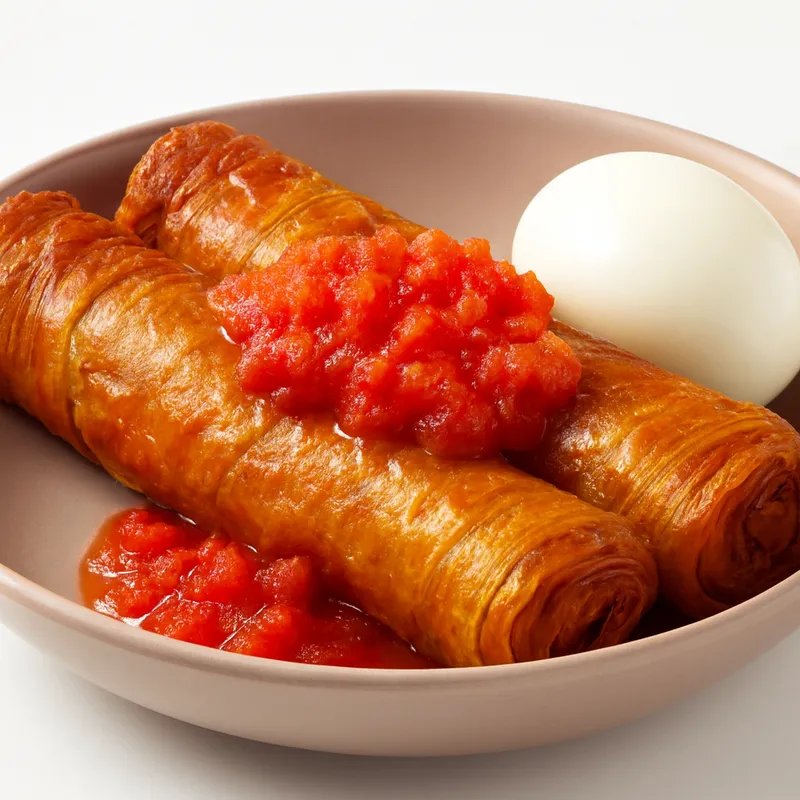
A tight coil of paper-thin laminated dough, butter or margarine between every layer, baked at 90 °C for ten hours until the outside turns mahogany and the inside pulls into stretchy strands. Served Saturday morning with a hard-boiled brown egg, crushed-tomato dip and zhug (Yemenite green chili sauce). Pulled apart with hands; if it doesn't unwind in long ribbons, it was underbaked.
It's a slow Maillard project — at 90 °C the sugars in the dough caramelise over hours rather than minutes, producing the deep brown without burning. The fat between layers melts and migrates, leaving microscopic air pockets that keep the dough chewy instead of dry. Yemenite Jews did not eat dairy with meat, so traditional jachnun used clarified butter or schmaltz — modern recipes use margarine for the same Sabbath-friendly reason.
Variations
Yemenite original (margarine, served with grated tomato, hard-boiled brown egg, zhug); Habani-Yemenite version uses clarified butter and is dairy-only; Adeni style is wider and shorter; Tel Aviv bakeries like Saluf & Sons do the canonical home format; the kubaneh (round pull-apart loaf) is the dairy cousin baked the same way.
On the Palate
Where Jachnun sits in the Israeli flavor cloud
Roll the dough paper-thin and cook it very low overnight — the whole magic is hours at around 90 °C, where the sugars slowly brown and the layered fat melts into tender, chewy coils.
Ingredients


How it's made
4 steps · 30 min active + 8 hours waiting
- 115 min
Roll out the dough thinly on a floured surface, creating a sheet that is smooth and even. Brush it generously with clarified butter, ensuring a glossy, even coating.
Watch outThe rolled sheet should be nearly see-through and evenly slicked with fat before you add honey — thin and glossy is the target.
- 25 min
Sprinkle a touch of honey over the buttered dough, then roll it tightly from one end to the other, creating a compact log.
Watch outToo much honey can make the dough overly sticky and difficult to roll.
- 35 min
Place the rolled dough in a lidded pot, ensuring the pieces are snug but not overcrowded. The lid will trap moisture during cooking.
Watch outOvercrowding the pot can lead to uneven cooking and steaming instead of baking.
- 45 min
Set the pot on a low heat source, such as a Shabbat hotplate. Cook the jachnun overnight, allowing it to turn a rich amber color with a sweet, caramelized aroma.
Watch outBy morning it should be a deep amber all through, smelling sweet and caramelized — pale color means the heat was too low or the time too short.
Archive tool suggestions — not reviewed
These legacy suggestions have not been evidence-reviewed and are not presented as required tools.