Leshan's defining street duck: braised whole in a dark spiced stock until the meat is fall-from-bone tender, deep-fried in two stages until the skin turns lacquer-red, then coated while hot with thick maltose that sets into a glossy, paper-thin brittle shell. The first bite cracks through sweetness into the savory warmth of star anise and cinnamon beneath; the meat stays juicy and fine-fibred throughout. The amber-sheened surface — compared locally to lacquerware — is one of the most recognisable sights at Leshan market stalls, sold whole and carried home.



Leshan sweet-skin duck — known locally as 卤鸭儿 (brined duck) or 油烫鸭 (oil-basted duck) — shares technique with a Qing-era folk preparation of oil-sparged duck, though a direct documented lineage has not been established. The clearest recorded strand begins in 1939, when Zhao Jinshan, a former rickshaw driver left jobless after wartime bombing raids on Leshan, set up a stall selling brine-and-fry duck at the salt-wharf market in Wutongqiao. His daughter-in-law Yang Fuqiong later took over and, through repeated trials, replaced rock sugar with maltose for the finishing glaze: ice sugar cracked and turned opaque on cooling, while maltose spread smoothly across hot skin and set into the flexible, luminous shell that defines the dish today. In 2022, Leshan city inscribed the technique on its municipal intangible-cultural-heritage register.
The skin is reddish-brown and glossy, sheathed in a thin sugar crust that cracks clean at the bite. Sweetness arrives first — not cloying, just bright — then the brine-warm depth of the braising stock blooms up, carrying star anise, cinnamon, and a faint numbing note of Sichuan pepper. The duck flesh beneath is fine-fibred and running with juices. Best eaten immediately: once the glaze softens to moisture, the essential tension between crack and tenderness is lost.
The technique locks three stages together — braise, fry, glaze — each one dependent on the previous. The braising stock is coloured with caramelised rock-sugar syrup (炒糖色): sugar heated in oil past its melting point undergoes Maillard reactions that generate the broth's red-brown tones and complex caramel depth; the spice bundle contributes volatile aromatics that penetrate the duck flesh over a long, slow simmer. Frying proceeds in two passes: a first bath around 160°C sets the skin without burning it, allowing surface moisture to escape; a second pass at 180°C drives subcutaneous fat outward through the skin, creating the blistered, crisp puff. Maltose is chosen over sucrose for the final glaze because its lower crystallisation tendency lets it spread evenly across hot skin and set as a flexible, translucent film — rock sugar by contrast resolidifies opaque and brittle.
Variations
Each Leshan stall guards its own spice formula; the main variables are the weight given to cardamom and clove versus the warmer notes of galangal and fennel, and how sweet the finished glaze runs. Old-school shops keep the sugar shell thin and let the brine note dominate; newer-generation shops apply a thicker coating. Some operators split the cooking across two days — braising on day one, frying and glazing to order — for a deeper, more complex spice penetration. A home-cook shortcut replaces the deep-fry with a high-heat oven blast. There is also a stir-fry variation in which chopped sweet-skin duck is tossed in a wok with shredded cabbage and fresh chilli.
On the Palate
Where Leshan Sweet-Skin Duck sits in the Chinese flavor cloud
Ingredients
Serves 4

How it's made
7 steps · 30 min
- 1360 min
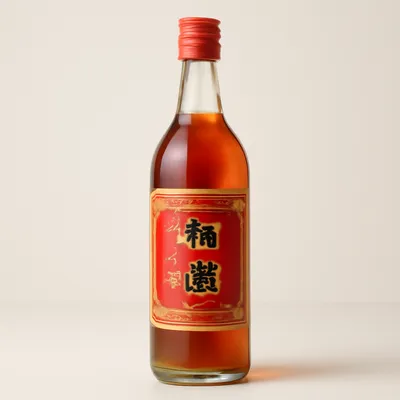
Clean the duck thoroughly. Make a 6 cm cut at the tail end, remove the organs, rinse, and pat dry. Rub Sichuan peppercorn, salt, and Shaoxing wine all over the inside and outside. Cover and marinate in the refrigerator for 5–6 hours.
- 210 min
Caramelise the sugar colour: heat a thin film of vegetable oil in a wok over medium-low heat, add crushed rock sugar, and stir constantly until fully dissolved and the syrup turns dark amber-brown. Immediately pour in a small ladleful of boiling water, stir to combine, and set the caramel base aside.
Watch outPour the boiling water in the instant the sugar turns dark amber — a breath later it burns black and turns the whole braise bitter.
- 390 min
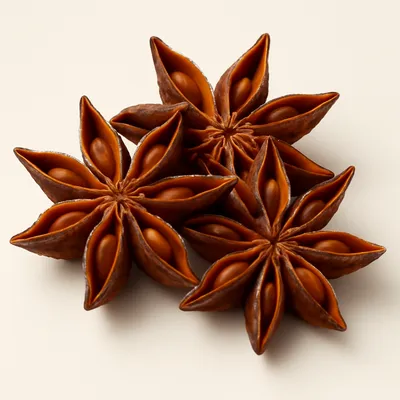
Build the braise: in a deep pot combine stock, the caramel base, Shaoxing wine, salt, ginger slices, and scallion knotted into a loop. Wrap Sichuan peppercorn, star anise, and cinnamon in a square of muslin and add to the pot. Bring to a boil over high heat, reduce to a low simmer, and let the stock develop for 30 minutes. Submerge the marinated duck, return to the barest simmer, and braise for about 1 hour until the thigh meat is fully cooked through. Lift out and drain on a rack.
- 410 min
First glaze: thin a spoonful of maltose with a little hot water to a brushable consistency. Paint the syrup evenly over the entire duck surface using a pastry brush. Air-dry for 10 minutes until the surface feels tacky rather than wet.
- 520 min
Deep-fry in two stages: heat a generous depth of oil in a wok to 160°C. Lower the duck carefully and fry, basting with hot oil over any exposed areas, for about 8 minutes until the skin sets and begins to colour. Lift out and rest on the rack for 2 minutes to let internal steam escape. Raise oil temperature to 180°C, return the duck, and fry for 3–4 minutes, turning once, until the skin is reddish-brown, puffed, and fully crisp. Drain.
Watch outFirst fry at the lower heat just sets the skin — rest it after so the trapped steam escapes, or the second fry won't crisp.
- 65 min
Final glaze: while the duck is still hot, pour or brush undiluted thick maltose generously over the whole surface, paying particular attention to the breast and back. Build a coating of roughly 2–3 mm. Allow to stand 3–4 minutes until the sugar shell firms and turns glossy.
Watch outBrush the final maltose on while the duck is still hot so it clings and sets into a glossy shell, not a runny drip.
- 75 min
Chop and serve: once the glaze has set, chop the duck through the bone into serving pieces. Arrange skin-side up on the platter and serve immediately while the crust is still crisp.
