A salt-cured and smoke-roasted whole duck from Shifang city in Sichuan's Deyang prefecture, pressed flat using bamboo frames during air-drying — the "board" that gives the dish its name. The duck is rubbed with dry-roasted salt and sealed in a spiced curing vat for twelve hours before being stretched, dried, and slowly roasted. Two forms emerge: raw pressed duck, which keeps for three to five months and is best steamed; and braised pressed duck (熟板鸭), slow-cooked in spiced brine until tender and deeply savory. Commercial production is documented to at least 1891, when the Li Wushi and Jiang Tiancong houses were already selling province-wide.



Shifang Pressed Duck's documented commercial history reaches to at least 1891, when two old-brand houses dominated the trade in Shifang city. Li Wushi's shop (字华国) was selling pressed duck across Sichuan and beyond by that date. The Jiang Tiancong family entered the curing business during the Guangxu reign period, passed the trade through three generations spanning over a century, and reportedly sold more than twenty thousand ducks annually. Both houses established the core technique: dry-roasting salt before rubbing, curing the duck in sealed vats with Sichuan aromatics, bamboo-pressing it flat, and finishing with low-heat smoke-roasting. Some local accounts hold that Cantonese migrants who settled in Shifang during the early Qing brought southern pressed-duck methods with them, which then merged with local spice traditions — though this account rests on regional sources only and cannot be independently confirmed.
Raw pressed duck steamed whole is the purest reading: as the steam rises, the deep-red cured skin turns clear amber-gold and the kitchen fills with the low, nutty fragrance of preserved meat. Under the knife the muscle fibers look dense and close-packed, yet the first bite melts quickly — a paradox built from careful salt-curing and long air-drying. Braised pressed duck is a different register: the brine has penetrated every layer, the belly skin turns soft and unctuous without heaviness, and the flavor is a quiet stack of salt, aromatic spice, and a faint sweetness that makes plain rice feel like the right answer.
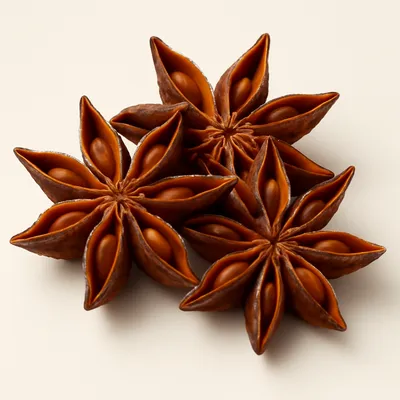
Two interlocked processes shape the texture of Shifang Pressed Duck: dry-roasted salt curing and slow low-heat drying. Dry-roasting the salt before use drives off all moisture and refines the crystals to a fine powder that penetrates the duck skin evenly without harsh surface burns; the toasting also unlocks faint Maillard notes that merge with the duck's own fat. Over twelve hours in the sealed vat, Sichuan peppercorn, star anise, and fennel diffuse into the subcutaneous fat layer, where their volatile aromatic compounds bind in a fat-soluble form rather than evaporating. Bamboo frames spread the carcass flat, maximizing surface area for even moisture loss without warping or pooling. The subsequent low-heat roasting (roughly 60–80°C) allows a gradual Maillard reaction: fat renders slowly, surface proteins brown, and the skin laminates into a lacquered golden shell. Salt has already partially denatured the myofibrillar proteins during curing; on steaming they re-gel into a texture that reads firm to the eye but melts without resistance.
Variations
Shifang Pressed Duck divides into two main streams. Raw pressed duck (生板鸭) comes in three sub-forms: whole bone-in pressed duck, boneless flattened duck patties (去骨鸭饼), and barrel-packed duck (桶鸭); all are sold uncooked and best finished by steaming, though braising with vegetables is also common. Braised pressed duck (熟板鸭), the street-food face of the specialty, is sold hot from the vat at local snack stalls, sometimes stewed alongside Sichuan peppercorn water and dried tangerine peel. Modern producers now offer vacuum-sealed braised versions for longer shelf life, though local patrons insist the dish only makes sense eaten moments after it leaves the brine.
On the Palate
Where Shifang Pressed Duck sits in the Chinese flavor cloud
Ingredients
Serves 4How it's made
6 steps · 20 min
- 110 min
Dry-roast the salt in a wok over low heat, stirring constantly, until no steam rises and the grains are completely dry. Add Sichuan peppercorn and star anise; toast for 30 seconds until fragrant. Remove from heat and allow to cool completely.
Watch outRub coarse salt into every surface and cure until it reaches the center — pull it early and the meat stays bland at the core.
- 2720 min
Rub the dry spiced-salt mixture firmly all over the duck — skin, cavity walls, and deep into any folds. Transfer to a deep container, scatter remaining salt mixture on top, press down, and cure in a cool spot for 12 hours.
Watch outBoil hard and skim the grey-brown foam until it runs clear — this is the only step that purges the blood and gaminess.
- 315 min
Lift the duck out of the vat. Rinse two to three times in warm water (about 40°C) to remove excess salt and any residual blood. Drain well and pat the cavity dry with cloth.
- 41440 min
Thread bamboo skewers through the duck at several points to hold it fully spread and flat. Hang in a well-ventilated place to air-dry for at least 24 hours, until the surface feels dry and taut.
- 5150 min
Roast the duck in a low oven (65°C) for 2 to 3 hours, turning once at the midpoint, until the skin is golden and visibly lacquered. Cool completely; the finished raw pressed duck can be stored for up to 3 months.
Watch outFry the sticks at 160–170°C until golden-crisp and the inside gives without resistance — a piece dropped in should sizzle at once without scorching.
- 645 min
To serve: steam the raw pressed duck over high heat for 35 to 40 minutes until fully cooked through. Rest 5 minutes off the heat, then chop through the bone into serving pieces and arrange on a plate.
Archive tool suggestions — not reviewed
These legacy suggestions have not been evidence-reviewed and are not presented as required tools.