


A humble staple of Black South African home cooking, rooted in Zulu and Sotho-Tswana kitchens and eaten as a partner to stews — tripe, oxtail and lamb, and in the Eastern Cape with umngqusho (samp and beans). Its exact origins are poorly documented; it is commonly thought to have arisen after Europeans introduced leavened bread to the region, with local cooks adapting it to their own boil-and-steam methods into this oven-free form. The same steaming technique, first used with millet and sorghum, carried over to maize and then wheat flour, and the dish spread through Black households as wheat flour displaced older grains in urban food supply across the 19th and 20th centuries. Its names vary by region and language: besides the Zulu terms, it is rostile in Xhosa, dipapata in Setswana, also called umbhako or simply 'bread of water.'
Southern African steamed bread tied to Zulu home cooking (idombolo) and Sotho-Tswana (ujeqe). Cooked in a covered pot on a cloth above simmering water — no oven, no oil. Steaming is the load-bearing choice; baking would crust and stop absorbing stew.
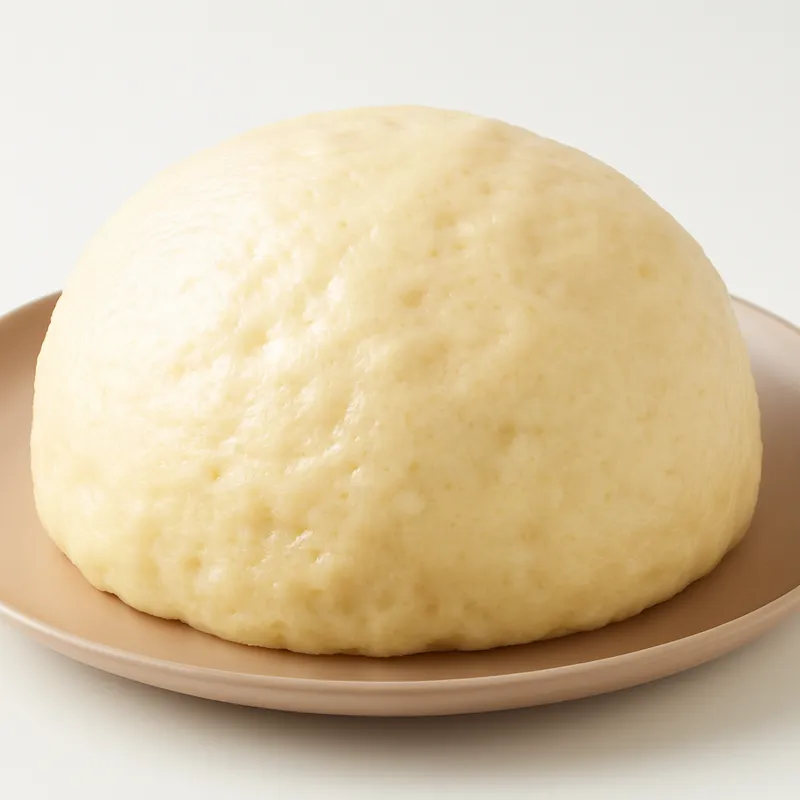
A pale, dense steamed dumpling-loaf, sliced into thick wedges, eaten alongside a meaty stew so it can soak up the gravy. Yeast-leavened, cooked in a covered pot over simmering water — no oven, no oil. Texture is between mantou and English dumpling: chewy, slightly tacky, with a clean wheat smell. Tear, don't cut, when serving with stew.
Steaming, not baking, is the load-bearing choice — it gives the bread the moist, crustless texture it needs to act as a sponge for stew; a baked loaf would crust over and stop absorbing. The most common method portions the proofed dough into containers — an empty tomato tin or a mug works — set in a covered pot with water reaching no more than halfway up the containers, steamed through. Some cooks skip the containers and instead line the pot with a clean cloth above the water line (no rack), letting the cloth soak up just enough steam to keep the dough's base from drying without sitting it in water. Either way, the point is to keep the dough wrapped in steam but never submerged.
Variations
The same dough takes different names — and a different character — depending on how it meets the pot. In Zulu kitchens, dough portioned into containers and steamed on its own is ujeqe, yielding a single soft white loaf; dough set directly on top of a simmering meat stew and cooked in its steam is idombolo. Which name means steamed versus stew-cooked varies by region and language and is debated even among speakers, with no settled answer. Urban township versions add baking powder for extra lift; Eastern Cape Xhosa cooks make a smaller hand-shaped version eaten with umngqusho (samp and beans).
On the Palate
Where Dombolo sits in the South African flavor cloud
Ingredients

How it's made
5 steps · 1 hour 30 min
- 13 min
Mix flour, yeast, sugar, and salt in a bowl.
- 215 min
Gradually add warm water to form a dough.
- 37 min
Knead until smooth and elastic.
- 415 min
Let dough rise in a warm place until doubled.
Watch outLet it rise in a warm spot until doubled and springy — press a finger in and the dent should ease back slowly; under-proofed dough steams up heavy and tight.
- 510 min
Steam over a pot of stew until cooked through.
Watch outSteam it through, don't let the water touch the dough — keep it above the waterline so it stays moist and crustless, the sponge that soaks up stew. It's done when a skewer comes out clean.
Archive tool suggestions — not reviewed
These legacy suggestions have not been evidence-reviewed and are not presented as required tools.