

Brought to Nagasaki in the 1550s by Portuguese missionaries — the name comes from pão de Castela ('bread of Castile'). When Japan closed to most foreigners during the Edo isolation (1639-1853), Nagasaki's Dejima island was the only port still trading with Europeans, and kasutera survived there as a Japanese specialty long after the missionaries left. By the 18th century Japanese bakers had refined it, swapping wheat starch for finer cake-flour technique and adding mizuame (a starch/malt syrup, mainly maltose) for moisture.
Brought to Nagasaki by Portuguese missionaries in the 1550s — pão de Castela, bread of Castile. Survived Japan's 1639-1853 closure on Dejima island. Mizuame (rice syrup) is what keeps the crumb moist for a week where Western sponge dries in two days.
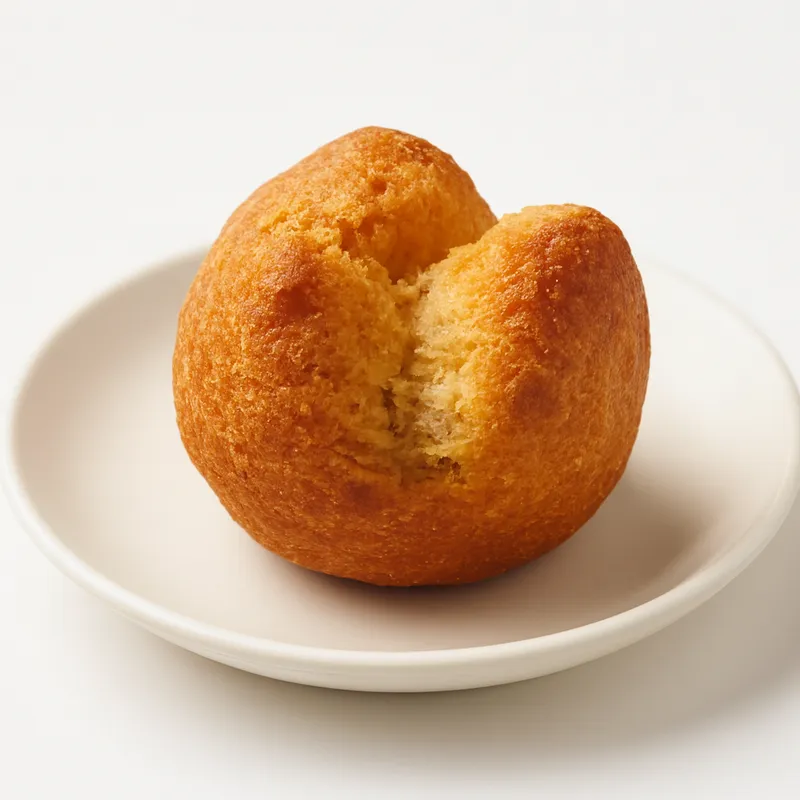
A loaf-shaped sponge cake, golden-brown crust on top and bottom, pale yellow crumb. The texture is moist and dense — closer to a pound cake than a Western sponge — with a chewy, slightly grainy bottom layer where coarse zarame sugar has settled and crystallized during baking. Best eaten in thick slabs, the day after baking, when the crumb has matured and the moisture has equalized.
Mizuame is what separates Japanese kasutera from European sponge. The maltose (starch/malt) syrup is hygroscopic — it pulls moisture from the air and holds it inside the crumb, which is why a properly made kasutera stays moist for a week without refrigeration, where Western sponge dries out in two days. The coarse zarame sugar at the bottom doesn't dissolve fully during baking; it stays as crunchy crystals — bakers without zarame use raw demerara, but the texture isn't quite the same.
Variations
Fukusaya (Nagasaki, since 1624) is the oldest house and still uses zarame at the base; Bunmeido (Tokyo, 1900) made it a national gift box; matcha kasutera is a 20th-century Kyoto adaptation; Taiwanese honey castella is the puffier humid descendant.
On the Palate
Where Kasutera sits in the Japanese flavor cloud
Ingredients
How it's made
5 steps · 1 hour 30 min
- 17 min
Beat eggs and sugar until thick and pale.
Watch outBeat the eggs and sugar until thick, pale and ribbony — lift the whisk and the trail should sit on the surface for a beat; this whipped-in air is the only lift the cake gets.
- 27 min
Stir in honey and mirin.
- 311 min
Gradually fold in sifted wheat flour until smooth.
Watch outFold in the sifted flour gently just until no streaks remain — stir hard and the gluten tightens, knocking out the air and leaving the crumb dense.
- 411 min
Pour batter into a lined loaf pan.
- 555 min
Bake until the top is golden brown and a skewer inserted into the center comes out clean.
Watch outBake until the top is deep golden and a skewer comes out clean — pull it early and the moist center sinks as it cools.
Archive tool suggestions — not reviewed
These legacy suggestions have not been evidence-reviewed and are not presented as required tools.