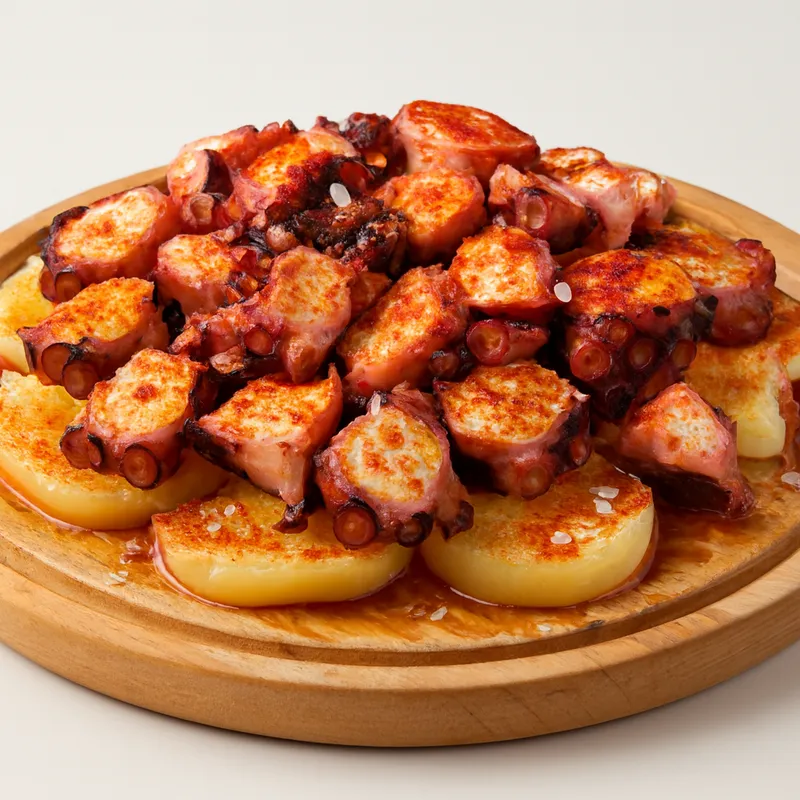
Albufera lake-area stew of river eel (anguila), garlic, paprika, potato, and dried chile — a fisherman's dish from the freshwater lagoon south of Valencia city.





All i Pebre comes from the Albufera, the freshwater lagoon south of Valencia city, where eel-fishing was a primary livelihood for centuries. Catalan and Valencian languages both contribute the name (Catalan: 'all i pebre' = garlic and pepper). The dish is documented in 18th-century Valencian cookbooks and is the signature dish of El Palmar, the lagoon village. It pairs traditionally with the same rices grown in the Albufera paddies — the eel is from the lake, the rice is from the dykes around it.
The signature dish of El Palmar village in the Albufera, where eel-fishing was the livelihood. Documented in 18th-century Valencian cookbooks. Eel-skin gelatin sets the broth — collagen melts at 70°C and re-sets glossy on cooling. Skin off, you get thin soup.
A rust-coloured shallow stew, the broth thickened by eel-skin gelatin to a gravy that coats the spoon. Eel flesh is dense, mineral, oily — closer to mackerel than to white fish — and the skin provides bouncy texture once it sets. Garlic is everywhere but mellowed by long oil-frying. Pimentón is the second seasoning, smoking the back of the throat with a slow heat from the picante. Sop with bread; the broth is half the dish. If your stew is watery, you didn't keep the skin on or you boiled too long after adding eel.
Eel-skin gelatin is the structural backbone — collagen melts at 70°C and re-sets into a glossy, lip-coating broth as the stew cools to eating temperature. Take the skin off and you get a thin soup. Pimentón is the second structural element; it's bloomed off-heat into oil at 80-90°C, where the carotenoids dissolve to colour the broth deep red without scorching the sugars in the powder. The mortar-pounded ñora paste adds bitter-sweet depth that powdered pimentón alone can't supply.
Variations
El Palmar village version (the canonical, with potato disks); inland Sueca cooks add ñora paste pounded heavier; modern Valencian restaurants often substitute monkfish (and sometimes conger eel) when river eel is scarce.
On the Palate
Where All i Pebre sits in the Spanish flavor cloud
Ingredients
Serves 4

How it's made
6 steps · 35 min active + 15 min waiting
- 15 min
Have your fishmonger gut and section 600g river eel into 5cm pieces — leave skin on; the skin produces the gelatin that thickens the stew. Pat very dry. Salt 15 min before cooking.
Watch outEel skin is slippery — wipe with coarse salt and a dry cloth before sectioning if your fishmonger hasn't.
- 24 min
In a 28cm earthenware cazuela, heat 80ml olive oil over medium. Slice 2 whole heads of garlic crosswise — yes, the entire head, peel-on — and fry 3 min until edges colour. Add 2 small dried ñora peppers (or 1 dried chipotle as substitute), fry 30 seconds; remove peppers and reserve.
Watch outDried ñoras burn in seconds — pull them the moment they puff and darken.
- 31 min
Pull the cazuela off heat. Stir in 1.5 tsp pimentón dulce + 0.5 tsp pimentón picante into the warm oil — the heat-off step is critical because pimentón burns at oil temperature and turns acrid in 5 seconds.
Watch outOff-heat means OFF — even residual flame will scorch the paprika.
- 412 min
Return to heat. Add 600g potatoes peeled and cut to 2cm chunks. Toss 1 min. Pour in 800ml hot water or fish stock. In a mortar, pound the rehydrated ñoras with a pinch of salt and a few of the fried garlic cloves to a paste; whisk into the cazuela. Bring to a hard simmer 10 min until potatoes are nearly tender.
- 510 min
Slide eel pieces in skin-side up, a single layer. Reduce to gentle simmer 8-10 min — eel cooks fast and overcooks faster, going from silky to woolly. Test with a fork: flesh should slide off the spine cleanly.
Watch outDon't stir hard once eel is in — the fillets break apart and the stew goes to mush.
- 65 min
Off heat. Rest 5 min so the gelatin sets the broth. Serve in the cazuela with crusty bread for sopping. Some Albufera cooks finish with a few halved garlic cloves rubbed on toast and floated on top.
Archive tool suggestions — not reviewed
These legacy suggestions have not been evidence-reviewed and are not presented as required tools.
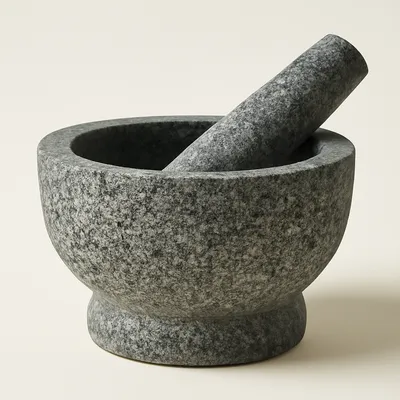
The simplest tool in any kitchen: a heavy bowl and a club to bash things in it. Different cuisines use different stones — Thai cooks pound green papaya in a tall granite mortar (krok hin); pesto Genovese requires the soft-pored Carrara marble; Indian masalas grind down on rough basalt. The bash-don't-cut motion releases volatile oils that a blade keeps sealed in the cell wall.

A round, shallow, glazed terracotta dish, 18-30 cm across with sloping walls, used for tableside-served Spanish tapas — gambas al ajillo, almejas a la marinera, callos, fideuà. Clay's slow heat retention keeps olive oil at the perfect 80-90°C garlic-confit zone for prawns without scorching, and the wide shallow profile lets liquids reduce while keeping protein lightly moored at the bottom.