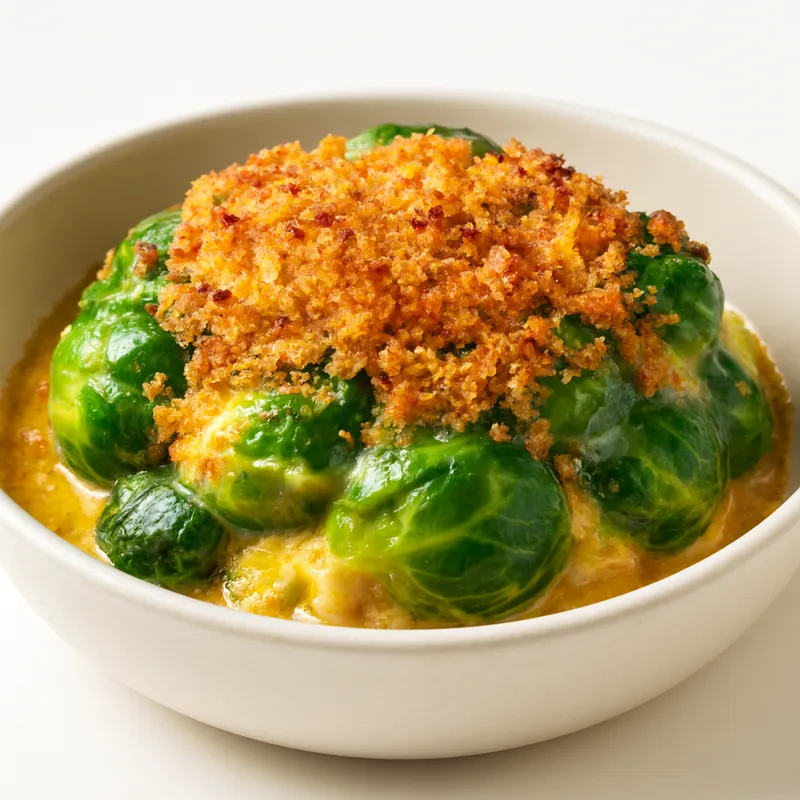
Brussels sprouts are baked in a creamy cheese sauce, topped with breadcrumbs for a rich and satisfying side dish.





Alsatian gratin tradition reaches back centuries — the word gratin (from gratter, to scrape) refers to the browned crust that forms on top — but Brussels sprouts only arrived in the region's gardens in the 19th century, after spreading from Belgian truck farms outside Brussels (where they were cultivated from at least the 1500s). The pairing is regional logic: Alsace's dairy country supplies the cream and Gruyère-style mountain cheese, the cold-weather brassica supplies the body.
Alsatian winter side — sprouts blanched, halved, layered in cream with Munster cheese (the local stinker, AOC since 1969) and breadcrumbs, baked until the top blisters. Bacon lardons are a Strasbourg addition.
Halved sprouts under a blistered crust of breadcrumb and Gruyère, pulled from the dish in clumps that string cheese. The cut faces have caught some color from a pre-blanch sear; underneath, cream has reduced to a clinging coat, not a pool. Nutmeg and black pepper come through last. Done right, the sprouts still have a faint snap at the core; turned to mush, the dish goes one-note.
The pre-blanch is non-negotiable: dropping halved sprouts into salted boiling water for 90 seconds sets the chlorophyll and pulls out the sulfurous bite that long oven time would otherwise concentrate into something cabbagey. Skip it and the gratin smells locker-room. The breadcrumb layer needs to go on dry, not soaked, or it won't crisp.
Variations
Strasbourg version adds smoked bacon and onion; Colmar version sticks to plain Munster; modern Parisian bistros use Comté instead for a milder funk; Belgian gratin de choux de Bruxelles uses béchamel rather than cream.
On the Palate
Where Brussels Sprout Gratin sits in the French flavor cloud
Ingredients




How it's made
4 steps · 35 min
- 17 min
Preheat your oven to 375°F (190°C). Trim the Brussels sprouts, then halve them and blanch in salted boiling water for 3-4 minutes until bright green and slightly tender.
Watch outPull the sprouts the instant they flash bright green and a knife tip just enters — a minute too long and they go army-drab and soft.
- 25 min
In a saucepan, warm the heavy cream with a pinch of nutmeg and minced garlic until just simmering. The aroma should be rich and fragrant.
Watch outWarm the cream only to the first lazy simmer around the edge; a rolling boil can break it into greasy flecks.
- 33 min
Drain the Brussels sprouts and arrange them in a baking dish. Pour the warm cream mixture over the sprouts, ensuring they are evenly coated.
- 420 min
Top with grated cheese, then bake until the cheese is melted and bubbly, about 20 minutes. The gratin should be golden and irresistibly aromatic.
Watch outDone is a bubbling, golden-brown crust; if the top is pale but time's up, hit it under the broiler for a minute.
Archive tool suggestions — not reviewed
These legacy suggestions have not been evidence-reviewed and are not presented as required tools.

Hand-held wire loop tool for beating eggs, whipping cream, emulsifying dressings, and incorporating air into batters. Balloon whisks (large round head) for whipping cream and meringues; French whisks (narrow tear-drop) for sauces in pots; flat whisks (gravy) for pan sauces. Stainless steel is universal; silicone-coated for non-stick pans.

Round metal pot, 14-26 cm diameter, with vertical walls and a long handle, designed for sauces, soups, oatmeal, rice, boiled vegetables. The vertical walls minimize evaporation (vs. a sauté pan). Sizes: 1 qt for melting butter, 2-3 qt for sauces, 4 qt for soups. Stainless-steel-clad aluminum or copper is best for conduction; cast-iron is too thick for delicate sauces.