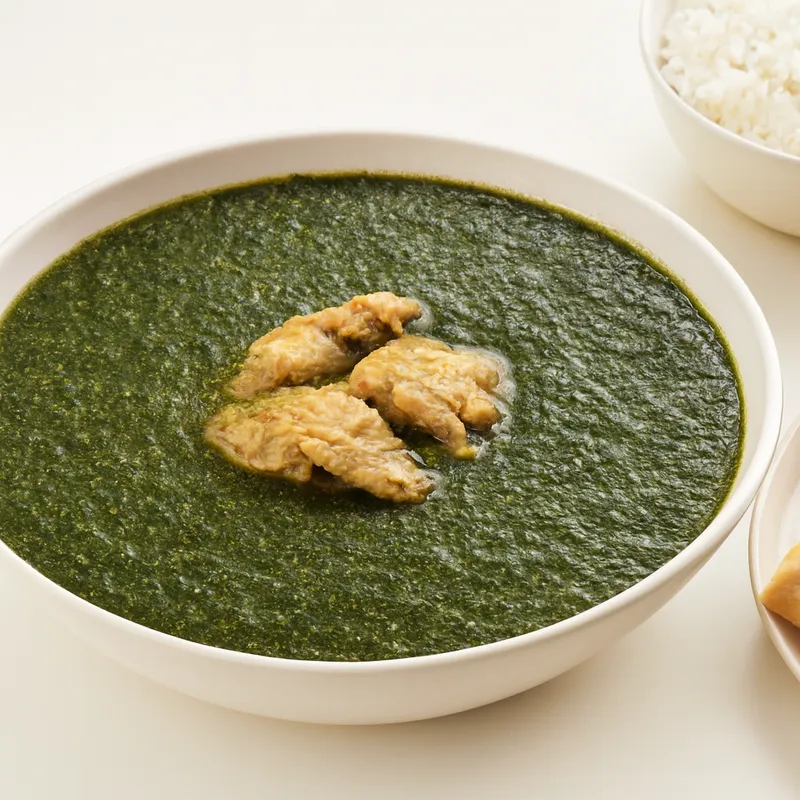
Soft, stretchy yam paired with a rich melon seed soup.
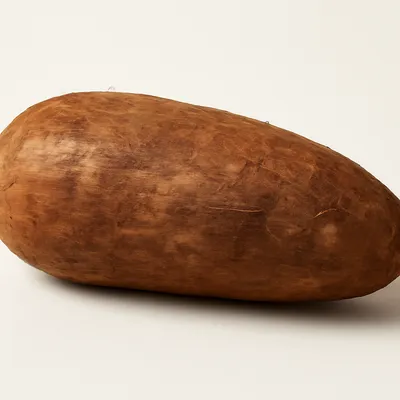


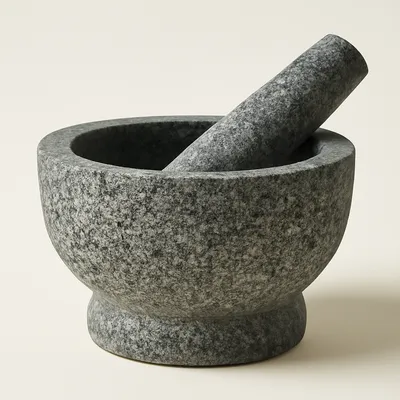
A defining dish of Yoruba southwestern Nigeria (and eaten across the south more broadly) — Dioscorea rotundata, the African white yam, is one of the world's independently domesticated yams, raised in the Niger River basin and the surrounding forest belt for at least 3,000 years, with some estimates of domestication reaching further back; it long predates cassava, a post-Columbian arrival from the Americas. Traditional preparation involves boiling chunks then pounding with a long wooden mortar (odo) and pestle for roughly 20 minutes — a two-person job, one pounding, one folding the dough.
Dioscorea rotundata, West Africa's white yam, has fed the forest belt for 5,000 years. Real iyan is pounded in a wooden odo for 20 minutes by two cooks — one striking, one folding — until it pulls a thread.
A glossy white mound of pounded yam, smooth as putty, sat next to or in a bowl of egusi soup. The yam stretches when you pull a piece off — it should pull a thread, not crumble. Pinch a chunk, dent it with a thumb, dip into the soup, swallow whole. Texture-wise it's the softest carb on earth; the soup carries every flavor.
Real pounded yam is genuinely pounded — the mechanical force breaks the yam's starch granules into long elastic chains, giving the trademark stretch. Food processors and yam-flour shortcuts (poundo) make a paste that looks right but doesn't pull a thread when you tear it. Igbo cooks use boiling water in the mortar to keep the dough from cooling and seizing mid-pound.
Variations
Iyan with egusi (ground melon seed, the standard pairing); iyan with efo riro (greens-forward); jute-leaf (ewedu) or okra soups also work; the cassava- or yam-flour-based amala is the darker swallow eaten alongside the same soups; poundo (instant yam flour) is the diaspora shortcut and rarely pulls a thread.
On the Palate
Where Pounded Yam and Egusi sits in the Nigerian flavor cloud
Ingredients
How it's made
3 steps · 1 hour 25 min
- 120 min
Peel and cut the yam into chunks, then boil in a pot of water until tender and easily pierced with a fork.
Watch outBoil until a fork pierces the chunk with zero resistance and it nearly falls apart — undercooked yam won't pound smooth.
- 210 min
Drain the yams and pound them in a mortar with a pestle until smooth and elastic, releasing their natural sweetness.
Watch outPound until the mass turns glossy, springs back, and pulls a visible thread when you tear a piece off.
- 355 min
Prepare the egusi soup by following the steps for Egusi Soup, ensuring the flavors meld perfectly with the pounded yam.
Watch outAvoid boiling the soup too vigorously to prevent separation of oils.
Archive tool suggestions — not reviewed
These legacy suggestions have not been evidence-reviewed and are not presented as required tools.