
A chilled, set mango pudding — pale apricot-orange, wobbling and sliceable, turned out of a mold or served in a cup. Sweet mango purée is bound with gelatin or agar, then topped with a pour of evaporated or coconut milk and diced fresh mango. A fixture of the Hong Kong dim-sum dessert cart since the 1980s, and distinct from mango pomelo sago: this one holds its shape.
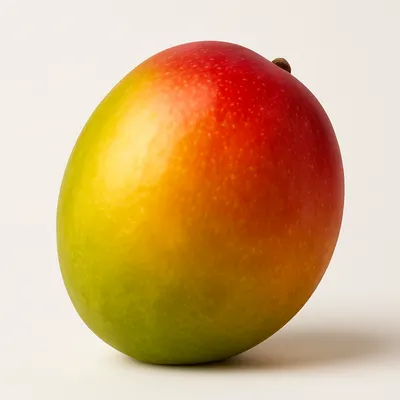


Mango pudding is a product of Hong Kong's dim-sum dessert culture in the 1970s and 1980s. As the city's tea houses and seafood restaurants expanded, the dessert cart began carrying cold, individually molded sweets alongside the steamed buns. A set mango pudding — made with imported Philippine and Thai mangoes and the gelling powders that had become cheap and common — suited the cart: it needed no steaming, kept its shape on a hot trolley, and could be turned out cold. Older recipes folded in a raw egg for richness, a practice most kitchens dropped after the avian-flu years. The West came to know it as a characteristically Hong Kong dessert, and from there it spread to dim-sum houses in Japan, Taiwan, and beyond.
Cold off the spoon, around 4°C. The first press meets a clean, trembling resistance, then it gives all at once — a gelatin set melts on the tongue near body heat into something almost creamy, while an agar set stays firmer and cleaner, with a Cantonese-style 'Q' springiness. Ripe-mango sweetness with a faint resin note, the evaporated-milk pour adding a cool dairy roundness, the diced fresh mango on top still fibrous and bright against the smooth body beneath.
Two setting agents give two textures. Gelatin is animal collagen (a protein): it sets only when chilled — typically several hours at fridge temperature near 4°C, at roughly 10–15 g per litre — and melts again near body temperature, around 35°C, which is why a gelatin pudding dissolves softly in the mouth. Agar is a polysaccharide from seaweed (石花菜/海藻): it gels as it cools below about 40°C, holds shape at room temperature, and melts again only near 85–95°C; at roughly 5–10 g per litre it gives the firmer, cleaner, sliceable 'Q' body. The trap is fresh mango. Like pineapple, papaya, and kiwi, raw mango carries protease enzymes (a cysteine-type protease in the flesh; the named relatives are bromelain in pineapple and papain in papaya) that cut gelatin's collagen proteins into fragments too short to re-tangle into a gel, so a pudding made with raw mango purée and gelatin will not set. The fix is to briefly heat the purée to denature the enzyme before mixing in the gelatin, or to use agar, a polysaccharide proteases cannot touch. That is why recipes tell you to cook the mango or reach for agar.
Variations
Agar versions give the firmer, sliceable 'Q' texture prized in Cantonese kitchens and are the practical, vegetarian, protease-proof choice for raw mango; gelatin versions are softer and melt in the mouth. Some shops fold in whipped cream for a mousse-like richness, others coconut milk for a tropical note; the classic finish is a pour of evaporated milk. Older restaurant recipes added a raw egg, now largely abandoned. The dessert is often turned out of a fish or rabbit mold for the cart, or set in individual cups. It is distinct from mango pomelo sago (杨枝甘露), an unset, pourable blend of mango purée, sago pearls, coconut and evaporated milk, and pomelo sacs.
On the Palate
Where Mango Pudding sits in the Chinese flavor cloud
Ingredients
Serves 4How it's made
8 steps · 20 min active + 3 hours waiting
- 18 min
Peel and pit ripe mangoes; blend the flesh into a smooth purée, reserving a few diced cubes for garnish.
- 26 min
Briefly heat the purée in a pot until it just steams (do not let it boil hard), which deactivates the natural protease so the pudding can set; if using agar this also primes it. Let cool slightly.
Watch outHeat the puree only until it just steams — a hard boil scorches the fruit, but this gentle heat kills the protease that would otherwise stop the pudding from setting.
- 35 min
Bloom the gelatin in a little cold water until soft (or whisk agar into water and simmer 2–3 minutes until fully dissolved).
- 44 min
Warm the sugar with water until dissolved; stir in the bloomed gelatin off the heat until clear (for agar, combine while hot).
Watch outStir the bloomed gelatin into warm (not boiling) syrup until fully clear — undissolved bits leave the pudding grainy and set unevenly.
- 53 min
Combine the mango purée, sweetened gelatin liquid, and evaporated milk; stir until even and smooth.
- 62 min
Pour into molds or cups and skim any foam from the surface.
- 7180 min
Chill in the fridge near 4°C for at least 3 hours, until fully set and wobbling.
Watch outChill at least 3 hours until it wobbles when nudged — that jiggle is the sign it's fully set but still soft.
- 83 min
Turn out or serve in the cup; pour over a little evaporated or coconut milk and top with the reserved diced fresh mango.
Archive tool suggestions — not reviewed
These legacy suggestions have not been evidence-reviewed and are not presented as required tools.


