
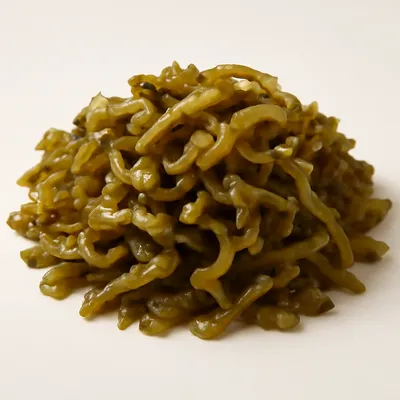
A Chongqing and Sichuan street staple of translucent sweet-potato starch noodles in a fierce hot-and-sour broth. The dried noodles are soaked and boiled until springy, then loaded into a bowl pre-loaded with a sauce built on vinegar (the sour), chili oil and Sichuan peppercorn (the heat and numbing), soy sauce, garlic, and ginger. Hot stock or boiling water is poured over to bring everything together, and the bowl is finished with crisp fried yellow peas, fried peanuts, chopped zhacai pickle, scallion, and coriander. Cheap, slurpy, and sharply sour-hot, it is eaten standing at a stall or carried off in a paper cup.




Hot-and-sour sweet-potato noodles are a modern folk street food of the Sichuan-Chongqing region; its exact origin is unrecorded. The dish is built on noodles made from sweet-potato starch, and the sweet potato itself only reached China in the late sixteenth century, during the Ming Wanli era, arriving by sea along several routes into Fujian and Guangdong — so no genuinely ancient sweet-potato-noodle tradition is possible. A folk tale popularly links the dish to the Three Kingdoms period, but this is legend rather than documented history and is not reliable. What is dependable is that the bowl took shape as a 20th-century street snack across western Sichuan and Chongqing, where home cooks pressed noodles from a blend of sweet-potato, pea, and other starches and dressed them to emphasize sourness and chili heat; from these folk roots it spread to street stalls and became a regional signature, now sold nationwide both fresh and as instant cups.
The noodles are the point: glassy and grey-translucent, thick and slippery, springy enough to bounce against the teeth and to stretch and slip rather than snap. You drink first, and the broth hits sour before anything else — a bright vinegar slap — then the chili-oil heat blooms and the Sichuan peppercorn sets a faint buzz on the lips and tongue. Against the slick noodles come bursts of crunch: crisp fried peas, fried peanuts, and the salty-sour crackle of zhacai, with scallion and coriander on top. Done well the noodles are taut and clear and the sour-hot is balanced; done badly they are bloated and pasty, breaking into stubs, and the broth is just harshly sour or numbingly salty.
Everything turns on the sweet-potato starch noodle. Dried, the starch has been gelatinized in boiling water then cooled and aged, during which its amylose chains re-associate and retrograde into a three-dimensional gel network; this retrograded structure is what makes the rehydrated noodle springy, translucent, and slip-not-break rather than soft like wheat noodles. Soaking and a short boil let the noodle take up water and the gel network swell and firm, so the texture is set by hydration, not by long cooking — overcooking floods the starch and turns it pasty. Traditionally alum (potassium aluminium sulfate) was added to the paste: hydrolyzed aluminium ions flocculate the starch and tighten the strands so they firm up and resist breaking in boiling water; because of aluminium intake concerns it is now restricted under China's additive rules, and many makers use alum-free methods with sweet-potato or potato starch alone. The flavor is a three-way balance poured over pre-cooked noodles: vinegar (acetic acid) for bright sourness, chili oil (capsaicin) for heat, and Sichuan peppercorn, whose hydroxy-alpha-sanshool triggers a tingling, numbing sensation; hot stock warms it through, and the crisp peas and peanuts give a textural foil to the slick noodle.
Variations
The two main schools are Chongqing-style, leaning heavier on chili oil and peppercorn numbing, and Chengdu-style, which often plays the sourness up. A widely loved richer version is 肥肠酸辣粉, topped with braised pork intestine; some bowls add ground-pork sauce, pickled vegetable, or a meatball. The same hot-sour seasoning crosses over to a numbing 麻辣粉 and to hot-pot-style 火锅粉. The noodle material varies: handmade sweet-potato noodles (手工红薯粉) are prized for spring, while some bowls use pea-starch (绿豆粉) or local sweet-potato 苕粉. Beyond the fresh stall bowl, instant cup versions (酸辣粉冲泡装) with dried noodles and a sauce packet are sold nationwide.
On the Palate
Where Hot-and-Sour Sweet-Potato Glass Noodles sits in the Chinese flavor cloud
Ingredients
Serves 2


How it's made
6 steps · 20 min active + 5 min waiting
- 190 min
Soak the dried sweet-potato starch noodles in warm water until soft and pliable, about 1-2 hours (or follow the package; fresh noodles need no soaking).
Watch outSoak only until the strand bends without a white core — soaked too long it goes limp and can't take the short boil.
- 25 min
Make the bowl base: in a deep serving bowl combine black vinegar, soy sauce, chili oil with its sediment, ground roasted Sichuan peppercorn, minced garlic, grated ginger, and a little salt and sugar.
- 36 min
Toast or fry the yellow peas and peanuts until crisp, and chop the zhacai pickle, scallion, and coriander.
- 43 min
Bring a pot of water (or light stock) to a rolling boil and cook the soaked noodles until springy and translucent, 1-3 minutes; do not overcook.
Watch outPull them the second they turn springy and clear, 1–3 minutes — overcook and the starch floods out and the noodles go pasty.
- 51 min
Lift the noodles straight into the seasoned bowl, then ladle the boiling stock or noodle water over to fill the bowl and dissolve the base.
- 62 min
Top with the crisp peas, peanuts, zhacai, scallion, and coriander; taste and adjust the vinegar and chili oil, and serve at once while piping hot.
Archive tool suggestions — not reviewed
These legacy suggestions have not been evidence-reviewed and are not presented as required tools.


