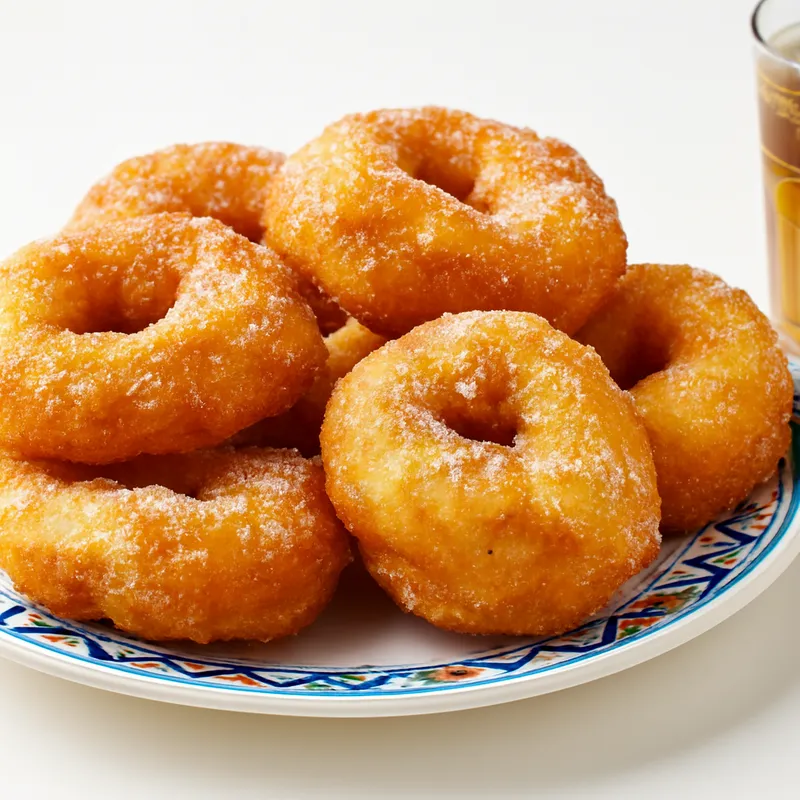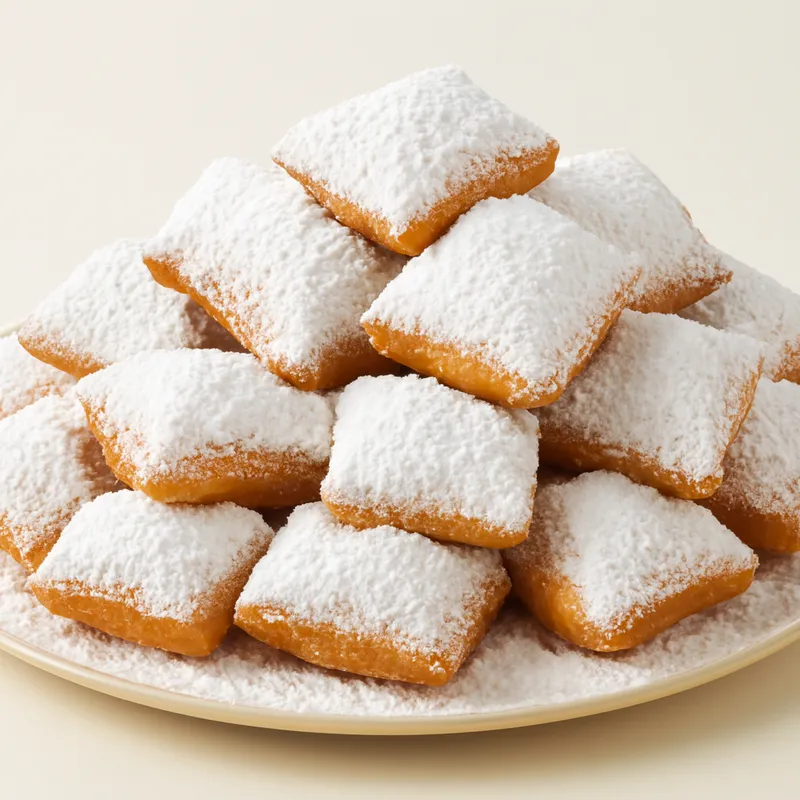
Deep-fried pastries dusted with powdered sugar.



A New Orleans French-Creole sweet, not a Cajun dish. Beignets descend from medieval French fritters served at Mardi Gras and were brought to Louisiana by French colonists in the 18th century, becoming part of home-style Creole cooking in New Orleans — distinct from the Acadian ("Cajun") country cooking of the Louisiana swamps. Café du Monde has fried them at the French Market in the French Quarter continuously since 1862, through the Civil War and ever since. In 1986 the Louisiana legislature named the beignet the official state doughnut.
Café du Monde has fried them in the French Quarter continuously since 1862; Louisiana made the beignet the official state doughnut in 1986. Yeast dough not baking-powder dough — that's where the hollow puff comes from. Sugar goes on while still steaming so it half-melts and clings.
Square pillows of yeasted dough, deep-fried until hollow, buried under a snowdrift of powdered sugar — usually so much that the first bite blows white powder on your shirt. Eaten hot with chicory coffee at Café du Monde, three to an order. The inside should be steam and air, not bread; if it's dense, the oil was too cool.
Yeast dough rather than baking-powder dough is the divider — yeast gives the hollow puff and slight chew. Oil must hit 360°F: lower and they soak grease, higher and they brown before the inside cooks. The sugar goes on while still steaming so it half-melts and clings; cooled beignets can't be rescued.
Variations
Café du Monde sticks to plain with chicory coffee since 1862; Café Beignet on Royal Street does a thicker dough; Loretta's Authentic Pralines fills theirs with crawfish for a savory version; Morning Call (Metairie) is the 24-hour rival.
On the Palate
Where Beignets sits in the Cajun flavor cloud
This rides on yeast dough plus the right oil temperature: yeast (not baking powder) gives the hollow puff, and the oil must sit right at 360–370°F so the squares balloon and set before they over-brown.
Ingredients

How it's made
6 steps · 55 min active + 1 hour waiting
- 15 min
In a bowl, dissolve yeast in lukewarm water with a pinch of sugar. Let it sit until foamy, about 5 minutes.
Watch outMake sure the water is not too hot, as it can kill the yeast.
- 210 min
Mix the yeast mixture with evaporated milk, granulated sugar, and melted shortening. Gradually add bread flour, stirring until a dough forms.
- 310 min
Knead the dough on a floured surface until smooth and elastic, about 8-10 minutes. Cover and let it rise in a warm place until doubled in size.
Watch outThe dough's ready when it doubles and springs back slowly to a poke — a warm, draft-free spot gets you there faster.
- 410 min
Roll out the dough to about 1/4 inch thickness and cut into squares. Heat oil in a deep fryer to 370°F (188°C).
Watch outCheck the oil temperature with a thermometer to ensure proper frying.
- 515 min
Fry the dough squares in hot oil until they puff up and turn golden brown, about 2-3 minutes per batch. Drain on paper towels.
Watch outSlide the squares in only when the oil shimmers; they should puff and float almost at once, flipping to deep gold on both sides.
- 65 min
Dust the warm beignets generously with powdered sugar before serving.
Watch outDust heavily the instant they drain, while the steam's still rising — that's the only window the sugar will melt and stick.
Archive tool suggestions — not reviewed
These legacy suggestions have not been evidence-reviewed and are not presented as required tools.