
A whole fish braised until the sauce is gone — the defining 干烧 technique. Unlike 豆瓣鱼, no starch thickening is ever used: the seasoned braising liquid is reduced slowly over low heat until it is almost entirely absorbed into the fish and clinging to its surface as a glossy, oily coat (自来芡). Built on pickled chili, doubanjiang and usually a little diced pork or ham, it is intense, savory and faintly sweet — the high-skill Sichuan fish dish, exemplified by 干烧岩鲤.
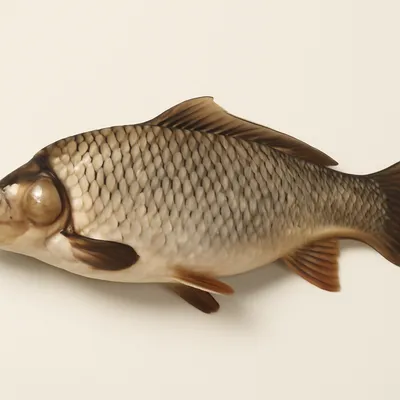




Dry-Braised Fish is the showcase of 干烧, a Sichuan braising method defined by what it refuses to do: thicken. Where most braises finish with a cornstarch slurry, 干烧 reduces the seasoned liquid entirely by heat until it is absorbed into the food or glazes its surface naturally — a self-made glaze the tradition calls 自来芡. The classic of the genre is 干烧岩鲤, made with rock carp from the Yangtze, a banquet dish demanding patience and heat control. A celebrated variant, 大千干烧鱼, is associated with the painter Zhang Daqian (张大千), known for his table as much as his brush. The pickled-chili-and-pork base and the dry finish are the through-line.
A whole fish sitting in almost no liquid, its surface lacquered in a dark red-brown sheen that is oil and reduced sauce, not a thickened gravy — you can see it cling, not pool. The flesh has absorbed the braise deep, so it is savory all the way to the bone, not just coated. Salty-spicy from doubanjiang and pickled chili, with a fragrant sweetness and the chew of diced pork or ham worked through. Richer and more concentrated than 豆瓣鱼; the plate should be nearly dry, glossy, intense.
Everything hangs on the reduction. The fish is fried more deeply than for 豆瓣鱼 — sometimes near-crisp — to firm it for the long braise and to render skin oil. Pickled chili (or 鲊辣椒), Pixian doubanjiang, diced pork and aromatics are fried down, stock and seasoning added, and then the fish is braised over steady low heat while the liquid is spooned over again and again and slowly cooks away. The rule is absolute: no cornstarch slurry. As the water evaporates, dissolved gelatin, oil and seasoning concentrate and coat the fish on their own — the 自来芡 — so timing and heat are the entire skill. Pull it too early and it is soupy; too late and it scorches. A little sugar and vinegar are balanced in before the liquid is fully gone.
Variations
干烧岩鲤 (rock carp) is the banquet benchmark; everyday cooks dry-braise carp, crucian carp, or grass carp the same way. 大千干烧鱼, tied to Zhang Daqian, is a noted named version. Many recipes work in diced pork, Jinhua-style ham, bamboo shoot or pickled mustard for body; 鲊辣椒 (rice-ground pickled chili) gives a deeper, less sharp heat than fresh 泡椒. The non-negotiable across all of them is the dry, un-thickened finish — add a slurry and you have made 豆瓣鱼 instead.
On the Palate
Where Dry-Braised Fish sits in the Chinese flavor cloud
Ingredients
Serves 3

How it's made
7 steps · 30 min
- 18 min
Score a whole cleaned fish on both sides; marinate briefly with salt and wine, and pat very dry.
- 27 min
Fry the fish in hot oil until both sides are firm and deeply golden, near-crisp; lift out.
Watch outFry the fish deep and firm, near-crisp on both sides — that sets it to survive the long braise without falling apart.
- 34 min
In the oil, fry diced pork until it renders, then add chopped pickled chili, Pixian doubanjiang, ginger and garlic until the oil runs red and fragrant.
Watch outFry the pickled chili and doubanjiang until the oil runs red and fragrant — that red oil is the color and flavor base of the whole braise.
- 42 min
Add stock with a little soy, sugar and salt; bring to a simmer and slide the fish back in.
- 55 min
Braise over low, steady heat, repeatedly spooning the sauce over the fish, turning once.
- 66 min
Continue reducing — without any starch — until the liquid is nearly gone and clings to the fish as a glossy coat.
Watch outReduce with no starch at all, spooning the sauce over until it's nearly gone and clings as a glossy coat — the dissolved gelatin thickens it on its own (自来芡).
- 72 min
Balance a little vinegar in at the end; lift the fish to a plate, spoon the last of the sauce and oil over, and scatter scallion.


