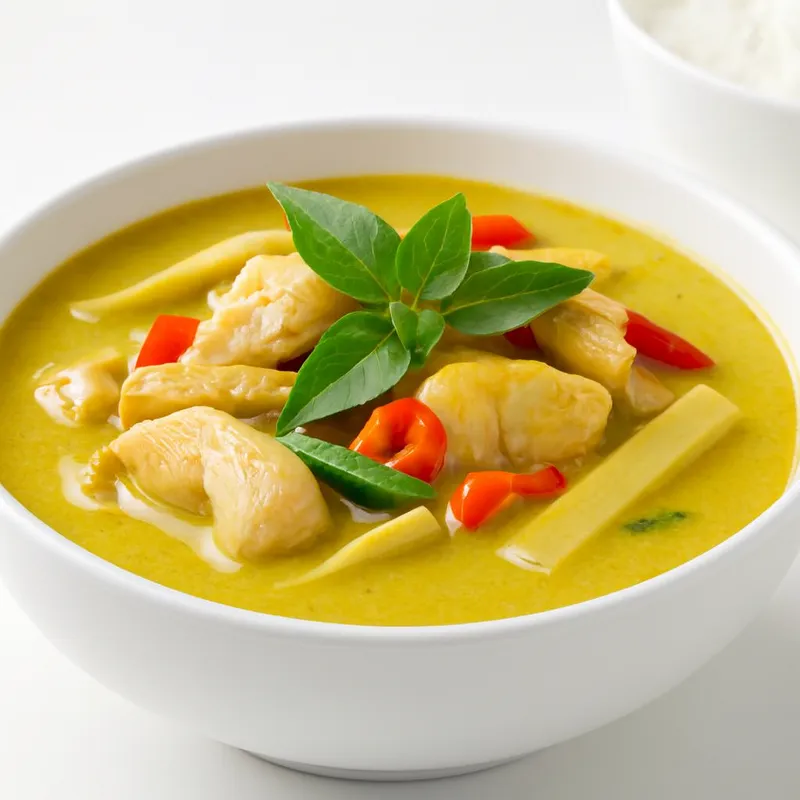
The canonical Thai red curry — coconut milk simmered with red curry paste (dried red chile, lemongrass, galangal, kaffir-lime peel, shrimp paste), chicken or duck, Thai eggplant and sweet basil.
Kaeng daeng — daeng means red — is the canonical Central Thai coconut curry and the reference point for the green and yellow curries (kaeng khiao wan / kaeng kari). The paste is built on dried red spur chiles for colour, lemongrass, galangal, kaffir-lime peel, coriander root, white peppercorn, garlic, shallot and fermented shrimp paste — the elements appear in 19th-century Thai recipe manuscripts, with the modern shape stabilizing in the early Bangkok Rattanakosin period as Indian-influenced spice elements (cumin, coriander seed) were adopted into the paste.
The reference Central Thai coconut curry — green and yellow are measured against it. The mechanic is taek man: cracking the coconut cream until water boils off and oil splits, then frying the paste in that coconut oil. Add palm sugar near the end so it caramelizes lightly.
An orange-red curry with a finger-thickness of crimson oil floating up top — the visual signature of any properly cracked Thai curry. First sip is the coconut sweetness, then the red-chile heat lands, then the long aromatic tail of lemongrass-galangal-kaffir lime. Eggplant has barely-set flesh and absorbs the curry like a sponge. The basil hits last, fresh and licorice-pepper. A red curry that's flat brown without an oil slick on top didn't get its paste fried hard enough — the difference between a Thai red curry and a watery stew lives entirely in step 3.
The mechanic is cracking the coconut cream — heating it until water boils off and oil splits out — so the curry paste is sautéed in coconut oil, not boiled in coconut milk. Frying the paste hard in that oil is what produces the red-oil slick on top of the finished curry; without it the paste flavour is muted and the curry looks flat. Add palm sugar near the end so it caramelizes lightly rather than dissolving into background sweetness.
Variations
Kaeng phet pet yang uses roast Cantonese duck simmered with pineapple, cherry tomatoes and grapes — an Ayutthaya royal-court dish; kaeng phet nuea uses braised beef; Bangkok Issaya Siamese Club plates a Royal-court version with pea aubergine; Krabi seafood houses run a shrimp-and-pineapple variant; Chiang Mai's Lanna red curry replaces some red chili with sa-tor (stink bean).
On the Palate
Where Kaeng Daeng sits in the Thai flavor cloud
Ingredients
Serves 4


How it's made
6 steps · 25 min active + 5 min waiting
- 16 min
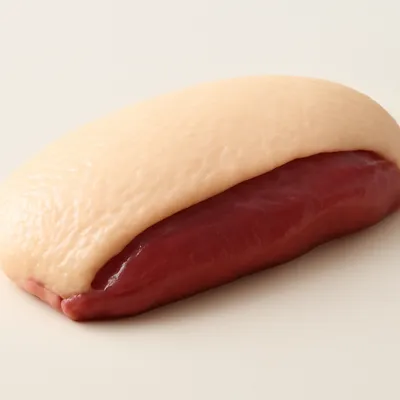
Cut 600g chicken thigh (or duck breast/leg) into 3cm pieces. If using duck, score the skin in a crosshatch and render 4 minutes skin-down in a dry pan first; reserve the rendered fat.
- 24 min
Open a 400ml can of full-fat coconut milk without shaking — spoon out the thick top cream (about 200ml) into a wok. Cook over medium-high until it splits into oil and grainy curd — 4 minutes. The cracked oil should smell strongly of coconut.
Watch outCook the coconut cream until it splits — glossy oil pooling out and grainy curd left behind, smelling strongly of coconut; that oil is where the paste fries, so don't stop while it still looks like milk.
- 33 min
Stir in 4 tbsp red curry paste (phrik kaeng phet daeng) and fry hard for 3 minutes until the paste is dark, glossy, and aromatic — the kitchen should smell mostly of dried-chile and shrimp-paste, raw smell gone.
Watch outFry the paste hard until it darkens, turns glossy, and the raw shrimp-paste smell is gone, replaced by dried-chile fragrance — that's what puts the red-oil slick on top of the finished curry.
- 412 min
Add the chicken (or duck) and toss in the paste 2 minutes until coloured. Pour in the remaining thinner coconut milk plus 200ml chicken stock. Simmer 12 min chicken / 18 min duck.
- 56 min
Stir in 2 tbsp nam pla (fish sauce), 1 tbsp palm sugar, 4 kaffir lime leaves torn, 200g Thai apple eggplant quartered, 80g pea eggplant. Simmer 6 minutes — eggplant should turn translucent, not mushy.
Watch outSimmer the eggplant just until it turns translucent — pull it there; go past and it collapses to mush instead of holding a tender bite.
- 61 min
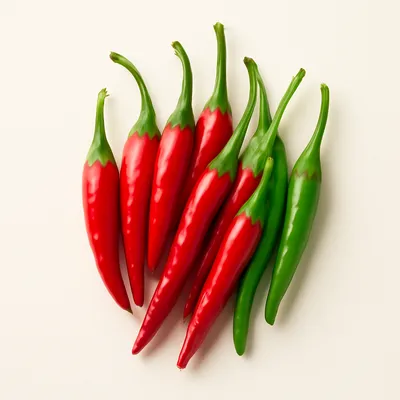
Off heat. Drop in a generous handful of horapha (Thai sweet basil) and 2 red spur chiles sliced on the bias. Spoon into a bowl — a slick of red oil should pool at the surface. Serve with jasmine rice.