Judiones de La Granja are giant white beans grown around La Granja de San Ildefonso in Segovia province, in the foothills of the Sierra de Guadarrama — the cool altitude and short growing season give them their distinctive size and thin skin. Brought from South America to the gardens of the Bourbon royal palace at La Granja in the 18th century — reputedly by Isabel de Farnesio, Felipe V's queen — the beans were first grown as forage for the palace pheasants and livestock. Parcelled out to palace servants, they were progressively selected over generations from a dark-purple bean to the white variety grown today. The stew form is older, a Castilian peasant pot dish that adopted the prestigious bean once it became regionally available.
Giant white beans selected in the 18th-century Bourbon palace gardens at La Granja de San Ildefonso, in the Sierra de Guadarrama foothills — cool altitude gives them their thumbnail size and thin skin. Cold-water splashes during the simmer shock the skin tight; pig's ear donates collagen the broth needs to cling.
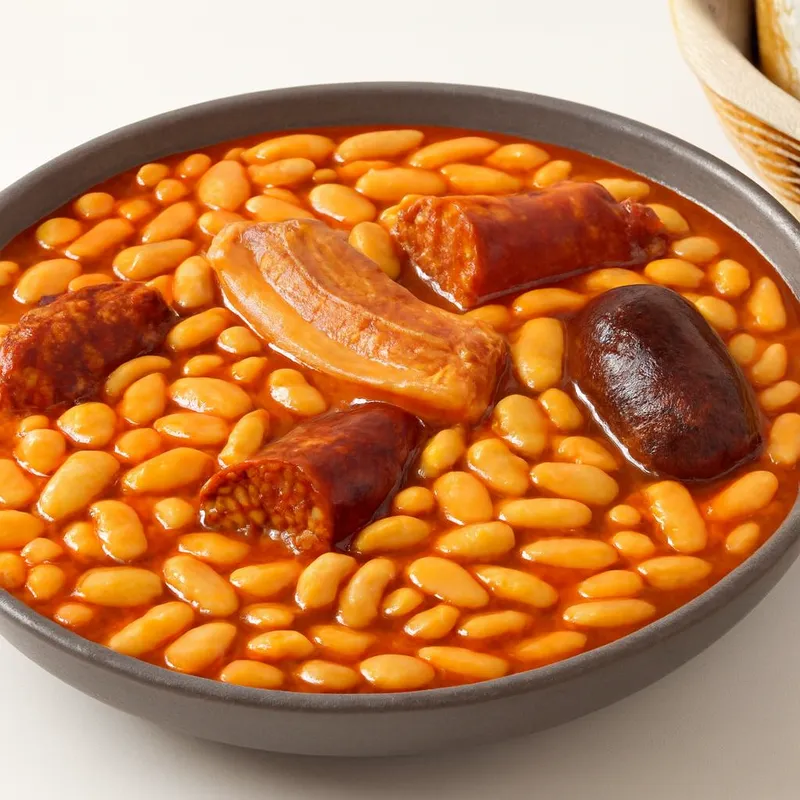
Each judión is the size of a thumbnail and ivory-white inside an intact dusty-pink skin — break it with a spoon and the centre is creamy as cooked custard. The broth is a deep brick-orange from chorizo fat and pimentón, gelatinous from the pig's ear and ham bone. A spoonful is bean, broth, a strip of pig's ear (translucent, gelatin-rich), a coin of dense morcilla. Eaten in winter from clay bowls. Beans split, mashed, or floury inside means the cook boiled too hard.
Two non-obvious tricks. First, the cold-water splash whenever the level drops — sudden temperature shock contracts the bean skin and seals it, preventing the bursting that would otherwise turn judiones into a starchy mash. Second, the pig's ear and ham bone are doing structural work, releasing collagen that thickens the broth into something that coats the beans. Without them you'd have boiled beans in red water, not the clinging, gelatinous stew that defines this dish.
Variations
Restaurante Reina XIV in La Granja anchors the regional version; Segovia capital cooks lean meatier; Asturian fabada uses fabes asturianas with a similar collagen logic; Tolosa's alubias are the Basque black-bean cousin.
On the Palate
Where Judiones de La Granja sits in the Spanish flavor cloud
Ingredients
Serves 6


How it's made
6 steps · 30 min active + 14 hours 30 min waiting
- 110 min
Soak 500g dried judiones de La Granja (or large butter beans) in plenty of cold water for 12 hours — they will double in size. Soak a 200g pig's ear and a 200g ham bone separately for the same time, changing the water once for the pig's ear.
Watch outUnder-soaked judiones split during cooking — at minimum 12 hours, water above the beans by 4cm.
- 215 min
Drain beans. Place in a heavy clay or cast-iron pot, cover with cold water by 5cm, add the soaked pig's ear, ham bone, 1 onion peeled and whole, 1 carrot, 1 bay leaf, 1 head of garlic halved across the equator. Bring to a slow boil, skim the grey foam.
- 3110 min
Drop heat to barest simmer — surface should just shiver. Cook 90-120 minutes uncovered, occasionally adding a splash of cold water if the level drops below the beans (the cold-water shock is a Spanish bean-cook's trick to keep skins intact).
Watch outBoiling = broken beans. Bare simmer = whole, creamy beans. Watch the surface — you want shimmer, not bubble.
- 48 min
While beans cook, in a separate pan render 50ml olive oil with 200g sliced cured chorizo and 150g morcilla cut into rounds. Brown 5 minutes — sausage releases red fat. Off heat, stir in 2 tsp pimentón de la Vera and 1 tsp sweet pimentón. 10 seconds.
Watch outPimentón goes off-heat — at sausage-pan temperature it scorches in seconds.
- 530 min
Stir the chorizo-morcilla mixture and all its red oil into the bean pot. Continue simmering 30 more minutes — beans go fully creamy, broth turns deep orange-red. Salt to taste.
- 635 min
Pull onion, carrot, garlic, bay. Lift out pig's ear, slice into thin strips, return to pot. Discard ham bone (meat already in broth). Rest off heat 30 minutes. Serve in deep clay bowls — beans should be intact, broth thick. Better the next day.
Watch outStirring vigorously now will smash the beans you spent hours keeping whole — gentle ladling only.
Archive tool suggestions — not reviewed
These legacy suggestions have not been evidence-reviewed and are not presented as required tools.