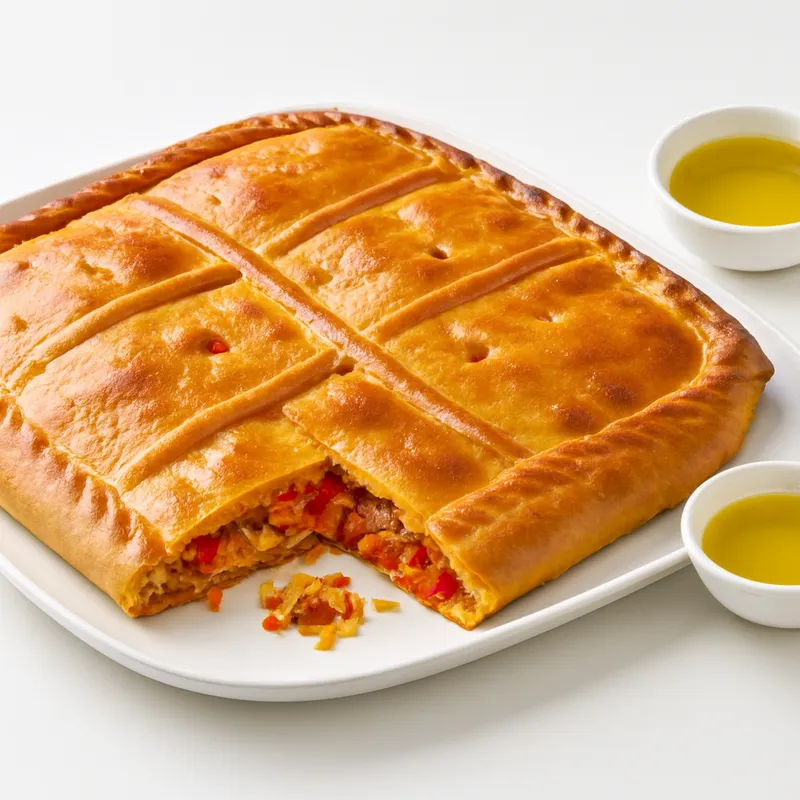
Empanada is documented in Galicia since at least the 12th century — a relief carving by Mestre Mateo on the Pórtico da Gloria of Santiago Cathedral (consecrated 1188) shows, in the Last Judgment archivolt, a figure representing the sin of gluttony eating what scholars identify as an empanada. La atunera, the tuna version, became the canonical recipe along the coastal Rías and on the Camino de Santiago because tinned tuna kept on the road. Pilgrims still buy it by the kilo from bakeries along the route. Galician empanada uses bread dough, not pastry — distinguishing it from the Argentine fried turnover descended from the same name.
Documented in Galicia since at least the 12th century — a relief on Santiago Cathedral's Pórtico da Gloria (consecrated 1188) shows two diners with an empanada. Galician dough is bread, not pastry; pimentón goes off-heat or it scorches bitter inside 10 seconds.
A square the size of your palm, top crust glossy mahogany, bottom crust thinner and oil-stained orange from the pimentón dough. Bite through and the filling is sweet from long-cooked onion, faintly smoky from pimentón, and the tuna shows up as flakes rather than a paste. Best the day after baking — overnight in the fridge the bread firms and the sofrito's flavours marry. Cold from a paper bag on the Camino is how Galicians actually eat it.
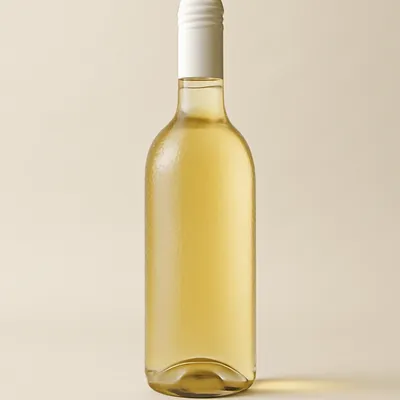
Three load-bearing details. One: the dough has olive oil and white wine in it — the oil tenderises gluten so the crust shears cleanly under a knife rather than chewing tough; the wine's acidity adds a subtle aromatic. Two: pimentón goes into both dough and filling, but always added off-heat — at frying temperatures it scorches bitter inside 10 seconds. Three: the filling cools fully before assembly because warm sofrito releases steam that gummies the bottom crust into pasta.
Variations
Atunera (tuna with sofrito, the Camino classic); empanada de zorza (raw-marinated pork); empanada de berberechos (cockle, Rías Baixas coastal); empanada de raxo with caramelized onion in Ourense bakeries.
On the Palate
Where Empanada de Atún (la Atunera) sits in the Spanish flavor cloud
Ingredients
Serves 8








How it's made
6 steps · 1 hour active + 3 hours waiting
- 1100 min
Make the dough. In a bowl mix 500g strong wheat flour, 7g instant yeast, 10g salt, 1 tsp pimentón dulce. Make a well, add 250ml warm water, 80ml olive oil, 60ml dry white wine. Mix to a shaggy dough; knead 8 minutes to a smooth elastic ball. Cover and proof 90 minutes until doubled.
Watch outThe pimentón colours the dough faintly orange — this is correct and traditional, not a mistake.
- 225 min
Make the sofrito (the la atunera filling base). In a wide pan warm 80ml olive oil, sweat 3 large yellow onions sliced thin and 2 red bell peppers in 1cm dice with a pinch of salt 25 minutes over low heat — onion goes translucent then sweet, peppers go silky. Don't brown.
Watch outPatience — under-sweated sofrito gives a watery filling that soaks the bottom crust.
- 318 min
Add 200g grated ripe tomato (or canned tomato passata), 1 tsp pimentón dulce off-heat, ½ tsp pimentón picante and a pinch of sugar. Cook another 15 minutes until thick, jammy and oil pools at the edge. Cool fully — hot filling melts the dough.
Watch outFilling MUST be cold or room-temp before assembly — warm filling soaks the bottom.
- 45 min
Drain 400g good-quality tinned tuna in olive oil (bonito del norte if possible), flake into the cooled sofrito, fold gently. Taste for salt — bonito-grade tuna is salt-cured and the filling rarely needs more.
- 512 min
Heat oven to 200°C. Divide dough in two — slightly larger half for the bottom. Roll the larger half to a 30×40cm rectangle, lift onto an oiled sheet pan. Spread filling to within 2cm of the edge. Roll the second half, lay on top, crimp the borders, cut a 2cm steam vent in the centre, brush with beaten egg.
Watch outCrimp tight — gaps in the seal leak filling oil and burn the pan.
- 660 min
Bake 35-40 minutes until top is deeply golden and the bottom (lift a corner) is dry-crisp. Cool 20 minutes on a rack — the filling sets and slicing stays clean. Cut into squares with a long knife. Eat warm or cold; better at room temperature next day.
Watch outIf the bottom is pale and wet, the oven was too cool or the filling too damp — return to 220°C for 5 minutes.
Archive tool suggestions — not reviewed
These legacy suggestions have not been evidence-reviewed and are not presented as required tools.