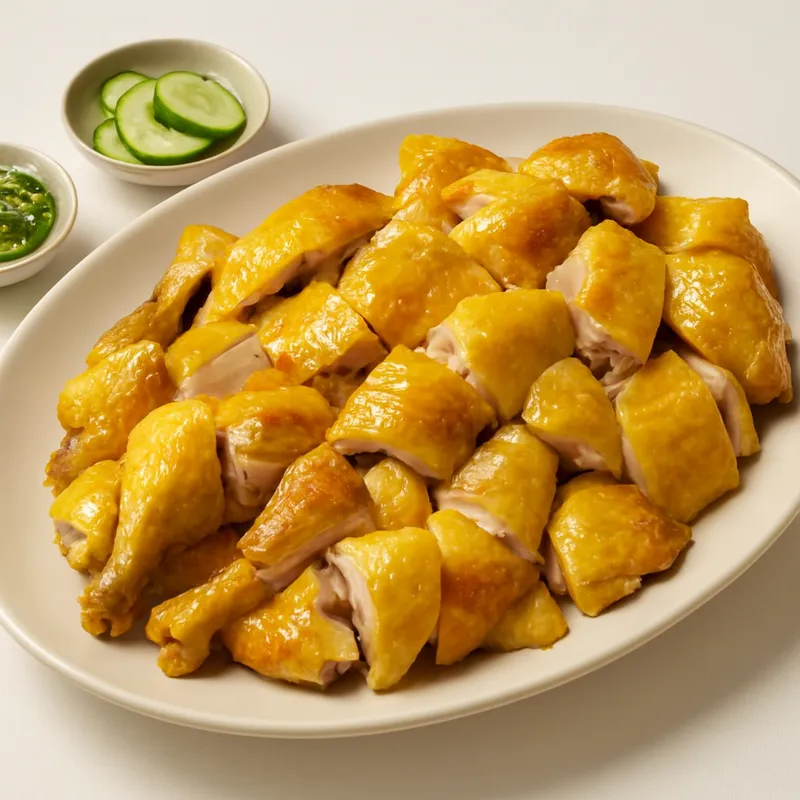
A savory steamed cake of grated white radish bound with non-glutinous rice flour, studded with cured sausage, cured pork belly, dried shrimp, and shiitake. Steamed firm in a tin, cooled until it sets, then sliced and pan-fried so the slices crisp golden outside and stay soft and pudding-like within. A year-round yum cha staple and one of the indispensable Cantonese Lunar New Year cakes, served with XO sauce or chili.





Radish cake is an anonymous folk cake of the Fujian-Guangdong coast with no recorded inventor or founding date. In Cantonese kitchens it belongs to the New Year quartet of steamed cakes alongside glutinous-rice cake, water-chestnut cake, and taro cake; the auspicious meaning rides on the homophone of 'cake' (糕, gou) and 'tall/rising' (高, gou), so eating it wishes a household 'higher year by year.' The familiar pun on 'radish' as a 'good omen' belongs not to Cantonese but to the Hokkien and Teochew speakers who call the dish 'cai tau guo': in their tongue the word for radish (菜头) sounds like 'good fortune' (好彩头), which is why the same cake carries an extra layer of New Year luck across Fujian, Teochew, and the overseas Hokkien communities.
A finger-thick slice, milky-opaque and flecked with pink sausage, amber shrimp, and dark mushroom. Pan-fried, the cut faces turn a crisp golden crust while the body underneath stays soft, dense, and faintly custardy — you should still taste the sweet pepperiness of the radish through the cured-meat richness. The contrast of brittle skin against the yielding interior is the whole point; a slice that is mushy through, or that crumbles apart in the pan, was either short on rice flour or fried before it had cooled and set.
The texture rests entirely on the choice of starch. Radish cake uses non-glutinous rice flour, which is high in amylose; glutinous rice flour, made of almost pure amylopectin, would set into a sticky, mochi-like mass that no knife could slice clean. When the cake steams, the rice starch swells and gelatinizes, drinking up the water that the grated radish releases (daikon is roughly ninety-five percent water). The cake comes out of the steamer too soft to cut — it must cool first, because as it cools the amylose re-associates into a firm gel network, a process called retrogradation, and only then does the cake slice cleanly. The final pan-fry browns the gelatinized starch surface through the Maillard reaction, giving the crisp golden crust.
Variations
A meatless version drops the cured pork and shrimp and leans on mushroom and dried bean curd. The Taiwanese 'cai tau guo' carries the highest proportion of radish, often unsalted and nearly plain. The radish-to-rice-flour ratio is a tunable lever rather than a fixed rule — more flour gives a firmer, denser cake, less gives a softer one. Note that the Singapore and Malaysian dish sold in English as 'carrot cake' is a different preparation entirely: it contains no carrot, and instead of pan-fried slices the steamed cake is cut into cubes and stir-fried with egg, garlic, and preserved radish, served white with light soy or black with sweet dark soy.
On the Palate
Where Radish Cake sits in the Chinese flavor cloud
Ingredients
Serves 6

How it's made
7 steps · 1 hour 30 min
- 120 min
Peel about 1 kg white radish and grate it into coarse shreds. Soak a handful of dried shrimp and a few dried shiitake until soft, then dice the mushrooms; dice the cured sausage and cured pork belly small.
- 212 min
Render the diced sausage and pork belly in a dry wok until fragrant, add the shrimp and mushroom and fry briefly, then add the radish and a little salt and white pepper; cook until the radish softens and gives up its water.
Watch outCook the radish until it softens and gives up its water — the shreds must release their moisture now or the steamed cake turns wet and won't set.
- 34 min
Whisk about 250 g non-glutinous rice flour with cold water (and a spoon of wheat starch if you like a smoother set) into a lump-free slurry.
- 43 min
Pour the hot radish mixture into the slurry off the heat and stir hard to a thick, even paste; the residual heat will partly thicken it.
Watch outPour the hot radish into the slurry off the heat and stir hard — the residual heat partly gelatinizes the starch into an even paste with no lumps.
- 555 min
Scrape the paste into an oiled tin, level the top, and steam over high heat about 50-60 minutes, until a skewer comes out clean.
- 660 min
Cool the cake completely — ideally chill it — so it firms up and can be sliced cleanly into finger-thick pieces.
Watch outCool the cake completely, ideally chilled, before slicing — warm it crumbles; only after the starch firms up will it cut clean into slabs that fry crisp.
- 712 min
Pan-fry the slices in a little oil over medium heat until both faces are crisp and golden. Serve hot with XO sauce or chili sauce.
Archive tool suggestions — not reviewed
These legacy suggestions have not been evidence-reviewed and are not presented as required tools.