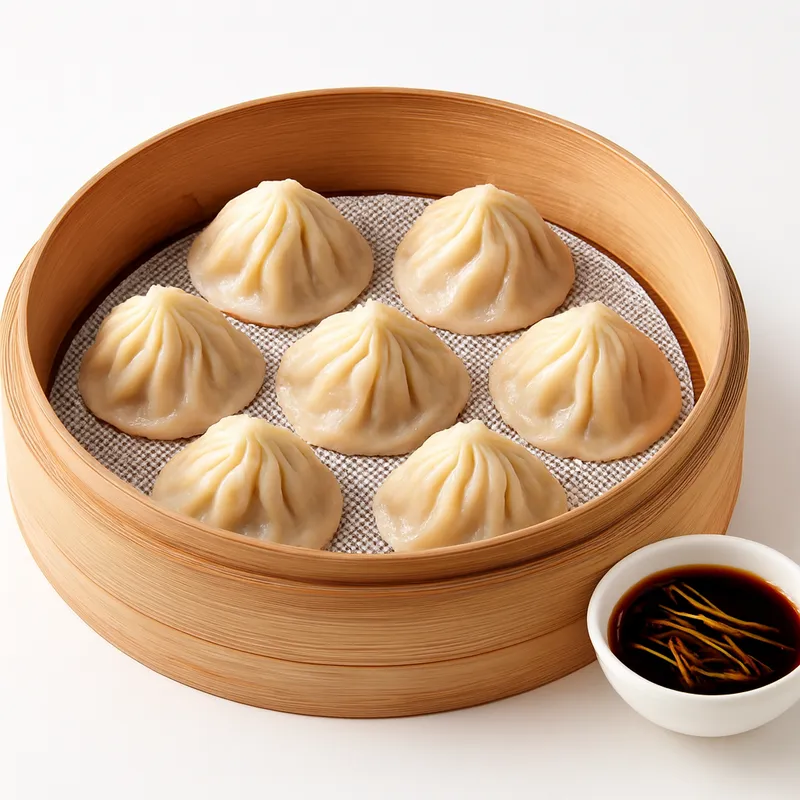
Braised North-and-South is a classic banquet dish of Zhangjiakou, the gateway-town cuisine of Hebei beyond the Great Wall. Its name pairs two regions on one plate: the "north" is kou-mushroom, the prized steppe mushroom that once moved south through Zhangjiakou's overland trade, and the "south" is bamboo shoot from Jiangnan. The two are sliced thin, blanched, and braised together in chicken stock, then bound with a light starch glaze and finished with a film of chicken fat. The result is silky mushroom against crisp-tender bamboo in a glossy, deeply savory sauce, half white and half amber.

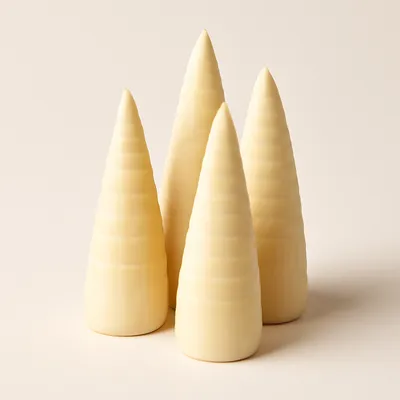


The dish belongs to Zhangjiakou (Kalgan), the Great-Wall pass that, founded as a market under the Yuan and flourishing through the Ming and Qing, served as the inland "dry port" funneling Mongolian and Russian goods toward Beijing. Steppe mushrooms gathered on the grasslands were graded and traded through the town, so people simply called them kou-mushroom, the "kou" being the kou of Zhangjiakou; in 1958 Guo Moruo, touring the city, wrote that the name "comes from Zhangjiakou, where the mushrooms on the pass are fine and many." Braising these northern mushrooms with southern bamboo shoot gave the dish its name: north plus south. A widely told local legend credits a Qing-era cook in Zhangjiakou and even has the Empress Dowager Cixi bestowing the name "north-and-south" while sheltering in nearby Xuanhua in 1900, but the named chef and the Cixi episode trace to a single storytelling source and are best taken as lore. As documented heritage the dish is firmly a Zhangjiakou specialty: it featured in the second season of the documentary A Bite of China and is counted among Hebei's ten classic dishes.
Soft, almost velvety mushroom slices give way to bamboo shoot that stays crisp-tender and faintly sweet. The sauce is light but clinging, lacquered with chicken fat so it gleams, and the flavor is a deep mushroom umami rounded by the richness of the fat and stock rather than by heavy seasoning. Aroma comes first: the toasty, meaty perfume of rehydrated kou-mushroom.
Everything turns on the dried kou-mushroom. Drying concentrates the mushroom's free glutamate and sharply raises its 5'-GMP, a nucleotide whose savory punch outdoes the inosinate of meat; glutamate and GMP multiply each other, so a rehydrated mushroom tastes many times more savory than a fresh one. That is why the cook soaks the mushrooms in warm water, then lets the cloudy liquid settle and uses the clear part as the braising stock rather than throwing it away. The chicken stock adds inosinate and the chicken fat adds dissolved aromatics, layering a second savory axis on the mushroom's. Bamboo shoot is blanched first to leach the oxalic acid and bitterness that would otherwise scratch the palate, leaving it clean and crisp. A thin cornstarch slurry gelatinizes into a sauce just thick enough to coat, and a final pour of chicken fat sits on top as a flavored film that carries aroma and gives the dish its sheen.
Variations
The bamboo "south" is most often dried yulanpian (sliced bamboo shoot) reconstituted, though fresh winter bamboo shoot is used in season; the "north" should be true kou-mushroom (the steppe Calocybe species), but commercial button mushrooms are a common stand-in now that genuine kou-mushroom is scarce. Some cooks braise in clear stock for a pale, elegant version, others use a touch of soy for the classic amber-and-white look. The dish is a close cousin of Shandong's shao-er-dong, which braises winter bamboo shoot with winter mushroom; the Hebei version is distinguished by its Zhangjiakou kou-mushroom and the chicken-fat finish. A vegetarian rendering swaps chicken stock and fat for a mushroom-and-soy stock and clear oil.
On the Palate
Where Braised North-and-South sits in the Chinese flavor cloud
Ingredients
Serves 4


How it's made
8 steps · 1 hour 10 min
- 160 min
Soak dried kou-mushrooms (or dried button mushrooms) in warm water for about an hour until fully swollen; lift them out, slice thin, and let the soaking water stand so the grit settles, then reserve the clear liquid.
Watch outLet the mushroom soaking water settle, then pour off only the clear top — that's your savory stock; the grit sinks to the bottom.
- 25 min
Slice the reconstituted or fresh bamboo shoot thin and even, matching the mushroom slices.
- 34 min
Bring a pot of water to a boil and blanch the bamboo shoot and the mushroom slices briefly, then drain; this removes the bamboo's harsh oxalic edge.
- 42 min
Heat a little oil in a wok, add the soy sauce to bloom in the hot oil, then pour in the chicken stock together with the reserved mushroom liquid.
Watch outBloom the soy in the hot oil for a second before the stock goes in — it wakes up the aroma; skip it and the sauce tastes flat.
- 52 min
Add the Shaoxing wine, a pinch of sugar and salt, then the mushroom and bamboo slices; bring to a boil.
- 618 min
Turn the heat low and let it braise and steep gently for about fifteen to twenty minutes, until the slices are cooked through and have drunk in the flavor.
- 72 min
Stir a little cornstarch with water and drizzle it in, swirling the wok until the sauce turns glossy and just coats the ingredients.
Watch outDrizzle the starch slurry in swirling the wok until the sauce just turns glossy and coats — a hair too much and it goes gluey.
- 81 min
Pour a spoonful of rendered chicken fat over the top, give the wok one gentle toss to glaze, and slide onto the plate.