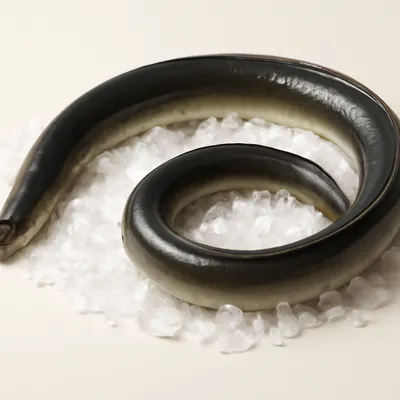
Linjiang Eel Slivers are the signature dish of Pingxing Town — formerly Linjiang Town — on the banks of the Linjiang River in Leshan's Shizhong District, built on a three-stage mantra locals recite by heart: boil to seventy-percent done, draw into long strands with an ox-bone knife, then braise in a mala red broth. Live freshwater eel is tipped into a rolling boil for three to five minutes, shocked in cold water to firm the flesh, then shredded along the muscle fibers into silky continuous strands using a blade ground from cattle rib bone — three strokes per fish. The strands braise in a base of pork lard and rapeseed oil with pickled chilies, doubanjiang, aged sauerkraut, and nearly twenty aromatics until deeply fragrant. At the table, scalding oil is poured over a bowl of dry chili powder, ground Sichuan peppercorn, and Chinese toon shoots, which crackle and bloom on contact; locals eat the eel the way they eat noodles — slurping great mouthfuls. The preparation technique was listed as a Leshan municipal intangible cultural heritage in 2022.





The precise origin of Linjiang Eel Slivers is disputed and impossible to verify through surviving records. Tradition holds that the dish arose in the Taichang area of Linjiang Town in the late Qing dynasty or early Republican period, attributed to a prominent local Luo family — a landowning clan said to have passed down the ox-bone shredding technique across generations. The mineral-rich water drawn from the area's deep wells and the quality of wild ricefield eel native to the Linjiang River made the locale especially suited to the preparation. For most of the twentieth century the dish remained a domestic tradition; in the early 1990s a handful of Linjiang restaurants began selling eel slivers commercially, and the dish spread rapidly across Leshan and into neighboring cities. The 'Linjiang Eel Sliver Preparation Technique' was recognized as a Shizhong District intangible cultural heritage in 2021 and elevated to Leshan municipal level in 2022, with a provincial-level nomination in progress.
A chopstickful of eel slivers slides into the mouth like a tangle of silky hand-pulled noodles — the flesh is soft and springy, coated in a red oil of pork lard and rapeseed, carrying the sour brightness of pickled peppers and the deep saline weight of aged sauerkraut. Sichuan peppercorn builds a steady buzz along the tongue before the chili heat arrives behind it, unhurried, the two sensations distinct and sequential. Just before serving, a ladle of smoking oil hits the dry chili powder and Chinese toon in the bowl with an audible crack, sending a plume of charred, herbal fragrance across the table. Locals suck the braised spine bones once the flesh is gone — there is a more concentrated depth in the bones than in the strands themselves.
The silky texture of the eel strands depends entirely on the precision of the seventy-percent boil. Live eel tipped into a full rolling boil for three to five minutes reaches the window in which skin collagen has begun to solubilize but muscle fibers have not yet fallen apart — at this point bone and flesh separate cleanly, and each fillet can be drawn into a long intact strand; even a minute too long and the strands snap under tension. The ox-bone knife, ground from cattle rib bone to a stiffness between a heavy cleaver and a fillet knife, provides just enough flex for the cook to sense the bone-flesh boundary in each stroke and guide three continuous cuts without severing the fiber. In the braising pan, pork lard and rapeseed oil combine as the fat base; the organic acids produced by lactic fermentation in the pickled peppers and ginger volatilize rapidly in hot fat, bonding with and carrying off the sulfurous odorants responsible for the eel's muddy smell. The final tableside step — scalding oil poured over dry chili powder, Sichuan pepper, and Chinese toon — drives a rapid burst of thermal reactions in the aromatics, generating the cascade of volatile esters and terpenoids that define the dish's signature scent.
Variations
The Linjiang tradition generates three canonical preparations: shredded slivers (the original form requiring the ox-bone knife technique), eel sections (cut pieces that simplify production for high volume), and braised eel bones (the extracted spine fried crisp and served as a drinking accompaniment or alongside the slivers). Leshan eel sliver noodles — shredded eel and mala broth poured over alkaline wheat noodles or rice noodles — have become a celebrated breakfast across the city. Modern variants from Pingxing Town restaurants include sweet-and-sour eel and tea-scented eel slices, though local consensus holds that the traditional mala red-broth preparation best expresses the pairing of the area's mineral-rich deep-well water with wild ricefield eel.
On the Palate
Where Linjiang Eel Slivers sits in the Chinese flavor cloud
Ingredients
Serves 2
How it's made
7 steps · 50 min
- 110 min
Kill and clean the live eel; rinse thoroughly. Bring a large pot of water to a vigorous rolling boil. Tip the eel into the boiling water, cover, and cook over high heat for 3–5 minutes until seventy-percent done — the flesh should separate from the bone without falling apart. Immediately transfer to cold water and let stand 5 minutes to firm the flesh.
Watch outPull the eel at seventy-percent done, 3–5 minutes — flesh lifts cleanly off the bone but the strands still hold; a minute too long and they snap under the knife.
- 210 min
Drain the eel and lay each one flat on a work surface. Using an ox-bone knife or a thin, slightly flexible boning knife, make three long strokes along the body following the muscle-fiber direction, separating the flesh from the spine into three continuous strands. Rinse the strands gently in cold water and drain well.
- 35 min
In a wok or wide pot, melt the pork lard with rapeseed oil over medium-high heat. Add the pickled ginger and pickled chili peppers and stir-fry until fragrant, about 2 minutes. Add the doubanjiang and stir-fry until the oil turns deep red, about 2 minutes more. Add star anise and fry 30 seconds.
Watch outFry the doubanjiang until the oil turns deep red and smells fragrant — that red oil is the base of the whole dish; rush it and the broth stays raw-tasting.
- 48 min
Pour in 600 ml water or unsalted stock and bring to a boil. Add the preserved mustard greens, whole garlic cloves, and dried chilies. Reduce heat to medium and simmer 5–8 minutes until the broth is richly flavored.
- 55 min
Add the celtuce or leafy greens and cook 1 minute until just wilted. Add the eel strands and return to a vigorous boil. Cook 2–3 minutes, stirring gently, until the eel is heated through and well coated in the red broth.
- 62 min
In each serving bowl, place 1 teaspoon dry chili powder, a large pinch of ground Sichuan peppercorn, and a small handful of Chinese toon leaves and cilantro. Ladle the eel and broth generously over.
- 71 min
In the wok, heat 3 tablespoons fresh rapeseed oil to smoking. Pour the sizzling oil directly over the aromatics in each bowl — they will crackle loudly and bloom with fragrance. Scatter sliced scallion over the top and serve immediately while the oil is still popping.
Watch outHeat the finishing oil until it just smokes, then pour it over the aromatics — it should crackle loudly the instant it lands; if it's silent the oil isn't hot enough to bloom the chili.


