Thick pork leg bones slow-braised in Dongbei fermented soybean paste and dark soy until the meat falls off in tender, lacquered strips — and the marrow inside is drawn out with a drinking straw, the richest reward the pot has to offer.
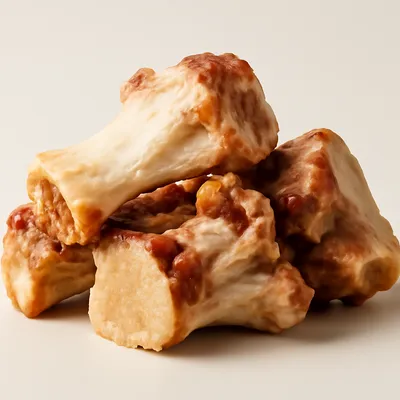




Harbin's soy-braised bone culture grew directly from the city's bone broth tradition. Wonton and noodle shops throughout Harbin's residential districts routinely simmered pork leg bones to produce the 老汤 (aged stock) regarded as the defining element of Harbin soup cooking. Once their collagen was surrendered to the stock, these bones were typically discarded. According to accounts of the city's food culture, stall operators in Harbin's neighbourhood hutong lanes began re-braising the spent leg bones in soy paste and spices and selling them as a standalone dish; speciality eateries dedicated to the preparation emerged in the city's residential alleys by the early 1990s. By the late twentieth century, 酱大骨棒 had become a fixture of Harbin night-market stalls and neighbourhood restaurants, widely cited among the top drinking foods of the northeast. The dish differs fundamentally from the closely related 酱骨架 (braised spinal rack): spine bones carry more meat while leg bones — 棒骨 — hold less flesh but far greater quantities of marrow, which is the dish's true prize. Every portion is served with a plastic straw for extracting the marrow from the bone shaft.
The meat near the bone is deeply soy-stained and falls away in slow-yielding strips; the marrow, drawn up through the straw warm and liquid, is shockingly rich — fatty, faintly sweet from the ice sugar, carrying the complex depth of the fermented soybean paste — the concentrated reward at the hollow centre of the bone.
Pork leg bones used for 酱大骨棒 are femur and tibia shafts — long bones with a central medullary cavity filled with yellow bone marrow composed primarily of saturated lipids (oleic and palmitic acid triglycerides), phospholipids, and residual haematopoietic tissue. During braising at 85–95°C over 90 minutes, the periosteum and surrounding connective tissue release their collagen, which hydrolyses into gelatin and thickens the braising liquid into a clingy, glossy sauce. Dongbei fermented soybean paste contributes both Maillard-derived browning compounds produced during months of fermentation and concentrated free amino acids — predominantly glutamate and lysine — that deepen savouriness. Combined with dark soy sauce's melanoidins and the caramelised glucose yielded by ice sugar in the final stage, three concurrent browning reactions build the dish's characteristic deep mahogany lacquer and layered sweetness. The yellow marrow inside the sealed bone shaft warms slowly and never exceeds 75–80°C even at full simmer, preserving its silken, near-liquid texture.
Variations
Some Harbin cooks add a splash of sorghum baijiu to the initial braising liquid, whose esters amplify the aroma of the fermented soybean paste; the Shenyang variant uses more dark soy and less soybean paste, producing a darker, more soy-forward glaze; the same master sauce is routinely used to braise pork trotters (酱猪蹄) without modification.
On the Palate
Where Soy-Braised Pork Marrow Bones sits in the Chinese flavor cloud
Ingredients
Serves 4



How it's made
7 steps · 20 min
- 115 min
Chop pork leg bones crosswise in half to expose the marrow cavity; place in a pot of cold water, bring to a boil, and simmer for 5 minutes; skim all foam, drain, and rinse the bones clean.
- 23 min
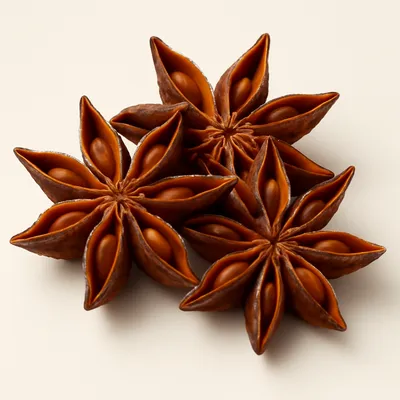
In a deep heavy pot, heat 2 tablespoons oil over medium heat; add ginger slices, star anise, cinnamon stick, bay leaves, and Sichuan peppercorns; fry until fragrant, about 1 minute.
- 32 min
Add the Dongbei fermented soybean paste; stir-fry for 1 minute until the paste darkens in colour and smells toasted.
Watch outFry the fermented soybean paste until it darkens and smells toasted — raw paste tastes flat and won't give the braise its deep savor.
- 42 min
Add the blanched bones; pour in dark soy sauce, light soy sauce, and enough boiling water to just cover; bring to a rolling boil.
- 560 min
Cover and braise over medium-low heat for 60 minutes, turning the bones once at the halfway point to ensure even colour and flavour penetration.
- 630 min
Add ice sugar; continue braising uncovered for 30 minutes, basting the bones every 10 minutes with the thickening sauce, until the meat is meltingly tender and the liquid has reduced to a glossy mahogany glaze.
Watch outReduce uncovered, basting, until the sauce turns a glossy mahogany glaze — that clinging shine is the melted collagen; a thin sauce needs more time.
- 72 min
Arrange the bones on a deep serving platter; pour all remaining sauce over; serve immediately with plastic drinking straws for extracting the bone marrow.
Archive tool suggestions — not reviewed
These legacy suggestions have not been evidence-reviewed and are not presented as required tools.

