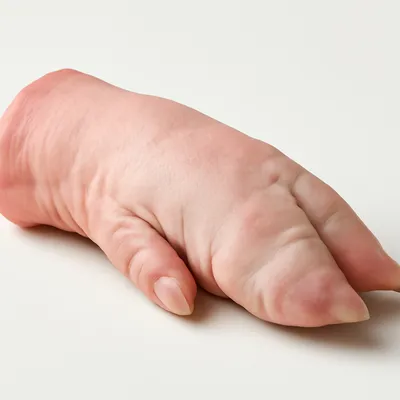
Pork trotters slow-braised in a soy and spice-infused master stock until the skin turns glossy and quivering, the collagen fully converted to silky gelatin—a nationwide Chinese comfort food.



The lu (master-stock braising) technique traces to the Qin dynasty expansion into Sichuan: after Qin Huiwang's general consolidated Bashu, governor Li Bing oversaw the drilling of salt wells in Guangdu, making well salt and Sichuan peppercorn the earliest documented ingredients of Chinese lu brine. The system matured through the Tang and Song, when street vendors selling lu-braised offal were a fixture in city markets. By the Ming dynasty, the incorporation of star anise, cinnamon, cloves, and other aromatics—documented in Li Shizhen's Bencao Gangmu—completed the flavor architecture of the classic lu broth. Pig trotters, inexpensive and collagen-rich, became the lu vendor's most popular item among laborers and dock workers.
A lacquered half-trotter arrives quivering on the plate. Pry a chunk of skin free—it stretches slightly before releasing, leaving a film of gelatin on the fingers. The skin and fat beneath are inseparably soft; the meat near the bone is slightly firmer. The five-spice and soy perfume is deep and rounded. Eating pig trotters with rice is a labor of happy patience: the bones have to be worked clean.
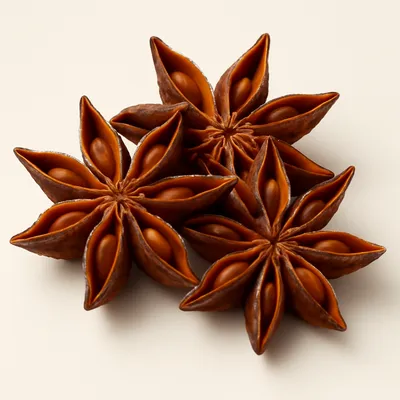
Collagen (Type I) comprises roughly 25–30% of pork trotter tissue by dry weight. Sustained cooking at 85–100°C for 90–120 minutes hydrolyzes the triple-helix collagen molecules into gelatin—disordered polypeptide chains that dissolve in the hot braising liquid and coat every surface. The Maillard reaction between soy sauce amino acids and the reducing sugars in the stock and caramelized rock sugar generates the deep amber color and layered savory aroma on the skin surface. Liposoluble aromatics from star anise (trans-anethole), cinnamon (cinnamaldehyde), and cloves (eugenol) dissolve into the fat and penetrate the tissue during the long braise; they are locked in as the gelatin sets on cooling and released again when the trotters are warmed for serving.
Variations
Red-braised trotters (hong lu) with soy-darkened caramel are the national standard. White lu (bai lu) omits the coloring and is preferred in Guangdong and Chaozhou for its cleaner taste. Hakka-style peanut-braised trotters add raw peanuts and a measure of red sugar for a sweeter, earthier result. Northern 'jiang zhu ti' uses fermented yellow bean paste as the primary seasoning.
On the Palate
Where Lu-Braised Pig Trotters sits in the Chinese flavor cloud
Ingredients
Serves 4



How it's made
8 steps · 30 min active + 1 hour 50 min waiting
- 110 min
Ask the butcher to split trotters in half lengthwise; blanch in cold water brought to a boil, cook 5 minutes, drain, and rinse under cold water to remove impurities.
- 25 min
In a wok over medium-low heat, fry rock sugar in a little oil until it turns amber; add the trotters and toss to coat in the caramel color.
Watch outFry the rock sugar to amber, not brown — pull it the moment it's amber and glossy; a shade past and the whole braise turns bitter.
- 33 min
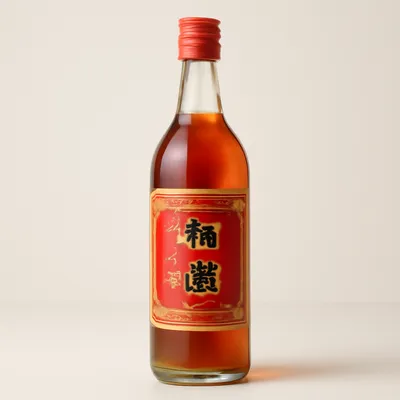
Add soy sauce, dark soy sauce, and Shaoxing rice wine; stir to combine.
- 43 min
Transfer to a large pot; add ginger, scallions, star anise, cinnamon, and bay leaves. Add enough water to barely cover the trotters.
- 53 min
Bring to a boil over high heat; skim any foam.
- 6100 min
Reduce to the gentlest simmer; cover and cook for 90–100 minutes, until skin is glossy and a chopstick slides through with no resistance.
Watch outBraise at the gentlest simmer until a chopstick slides through with no resistance — a hard boil breaks the skin and toughens the meat.
- 710 min
Remove lid; raise heat to medium and reduce the braising liquid by about one-third until it coats the trotters in a thick sauce.
Watch outReduce the liquid until it coats the trotters in a thick sauce — stop while it's watery and nothing clings.
- 82 min
Serve hot with white rice, or cool overnight so the gelatin sets into a cold jellied version.
Archive tool suggestions — not reviewed
These legacy suggestions have not been evidence-reviewed and are not presented as required tools.


