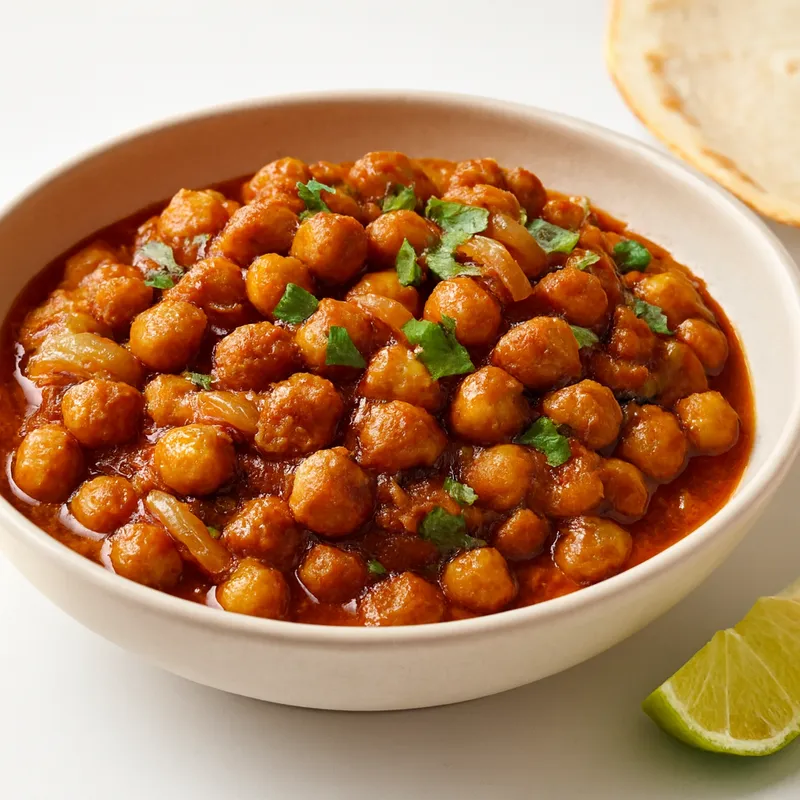
A whole hard-boiled egg encased in spiced minced lamb, shaped by hand, deep-fried until mahogany-brown, then simmered in a rich tomato-cream korma gravy. The cut cross-section — a yellow yolk ringed by white egg white inside a dark meat shell — mirrors the Persian narcissus flower (nargis), for which the dish is named.



Nargisi kofta belongs to the Mughlai tradition that carried Persian meatball (kofta) technique into India, where a hard-boiled egg is wrapped in spiced minced meat and fried so that the sliced cross-section — yolk ringed by white — echoes the narcissus flower, nargis in Persian, a bloom rich in Mughal poetic symbolism. Its precise inventor is unrecorded, and both Lucknow (Awadhi) and Hyderabad claim it as part of their nawabi heritage. The Mughlai synthesis of Persian kofta technique with Indian spice palettes unfolded across the imperial courts of the 16th–18th centuries. The dish is also often cited as a possible ancestor of the British Scotch egg: one 1987 historical speculation holds that koftas such as nargisi kofta may have inspired the breaded egg later brought home by British colonials.
The first cut releases a rush of steam from the korma gravy; the mahogany meat shell gives way to silky egg white and a crumbling, richly orange yolk. The fried crust carries caramelized, nutty notes from high-heat browning; the interior is soft and mildly sulfurous, with the spiced lamb providing a savory frame against the gentleness of the egg.
Deep frying at 175–185°C initiates the Maillard reaction between amino acids and reducing sugars on the lamb's surface, forming the dark, flavor-dense crust within 2–3 minutes. The meat shell insulates the already-cooked egg from direct heat, preventing the white from toughening or the yolk from turning rubbery. Besan (chickpea flour) in the mince mix gelatinizes during frying, acting as a binder that holds the shell together and traps moisture within the meat layer. The subsequent braising in tomato-cream gravy adds a second phase: tomato's acidity (pH ~4) partially firms the outer meat surface, while cream fat disperses into the sauce through emulsification, yielding a velvety, enriched body.
Variations
In Hyderabad, the koftas are sometimes made with beef mince and finished in a coconut-milk gravy rather than cream. Some recipes substitute quail eggs for a cocktail-sized presentation. A baked variation, popular in lighter Awadhi household cooking, uses oven dry heat to develop browning without immersion frying.
On the Palate
Where Nargisi Kofta sits in the Indian flavor cloud
Ingredients
Serves 4



How it's made
7 steps · 15 min
- 112 min
Boil eggs for 6 minutes; transfer immediately to ice water; peel and pat dry with kitchen paper.
- 25 min
Combine lamb mince with ginger-garlic paste, garam masala, turmeric, red chili powder, besan, and salt; knead firmly until the mixture is sticky and holds its shape.
- 38 min
Divide mince into 4 equal portions; flatten each into a disc; place one peeled egg in the center; wrap mince evenly around the egg; seal all joins by pressing firmly with wet palms.
Watch outWrap the mince evenly around the egg and seal every join with wet palms — any crack or thin spot splits open in the hot oil and the egg pops out.
- 430 min
Place wrapped koftas on a plate; refrigerate for 30 minutes to firm the meat shell.
- 516 min
Heat oil to 175°C in a deep wok; gently lower koftas in one at a time; fry, turning slowly, until uniformly golden brown, about 4 minutes per kofta; drain on a rack.
Watch outFry at a steady moderate heat, turning slowly, to an even golden-brown — too hot and the crust blackens before the shell heats through.
- 615 min
In a separate pan, sauté sliced onions in oil until deep golden; add ginger-garlic paste, tomato purée, garam masala, turmeric, and red chili; cook until oil separates, about 12 minutes.
Watch outCook the onion base until the oil clearly separates out — that split is the sign the raw taste is gone and the gravy has real depth.
- 712 min
Slide fried koftas into the gravy; simmer on low heat for 10 minutes; stir in cream; garnish with fried onion rings and fresh coriander; serve.