
A square cake of glutinous rice, mung bean paste, and pork belly wrapped in dong leaves that dye the rice green; boiled overnight and offered on the ancestor altar at Tet — Vietnam's most mythologically loaded dish.
Banh chung is Vietnam's deepest-rooted dish, traced in the Linh Nam Chich Quai legend to Lang Lieu, the sixth Hung king's son who won succession by offering his father a square cake (banh chung, representing Earth) and a round cake (banh giay, representing Heaven) made from rice — rejecting exotic mountain-and-sea ingredients in favour of what farmers grew. Whether or not the legend dates as claimed (the Hung kings are semi-mythical, ~2900-258 BCE), banh chung is documented as Tet centerpiece for at least a millennium. Northern households still wrap together on the last day of the lunar year, with the overnight boil being the family's New Year vigil.
Vietnam's deepest-rooted dish, traced in Linh Nam Chich Quai legend to Lang Lieu, the sixth Hung king's son who won succession with a square cake (Earth) and a round banh giay (Heaven). The jade tint is dong-leaf chlorophyll — banana leaves don't shed it; 10-12 hour boil welds the rice, 4-6 hour press gives sliceable density.
Cut open: a square of jade-tinted rice (the colour comes from dong-leaf chlorophyll, not added pandan), enclosing yellow mung bean and a slab of pork belly so long-cooked it surrenders to the spoon. Rice is dense, chewy, salt-edged; bean is silky and peppery; pork fat has melted into both. Eaten with sharp pickled scallion to cut the richness. The whole leaves are saved with the cake — they're part of how it presents on the altar, and they keep cut faces from drying.
The green colour is dong-leaf-driven: chlorophyll leaches from leaf to rice during the long boil only because dong (Phrynium placentarium) sheds it freely under heat — banana leaves, used for southern banh tet, do not. The square shape requires a wooden frame for first-time wrappers; experienced hands skip it. The 10-12 hour boil welds the rice into a sliceable mass; the 4-6 hour press afterwards is what makes the cut faces sharp rather than crumbly. Cool whole, sliced cold or pan-fried — never sliced hot.
Variations
Tranh Khuc village outside Hanoi is the named banh-chung specialist hamlet; Bac Ninh households add fatty pork shoulder over belly; the modernist banh chung gu (lying-down rectangular variant) is from Lang Son in the north.
On the Palate
Where Banh Chung sits in the Vietnamese flavor cloud
Ingredients
Serves 8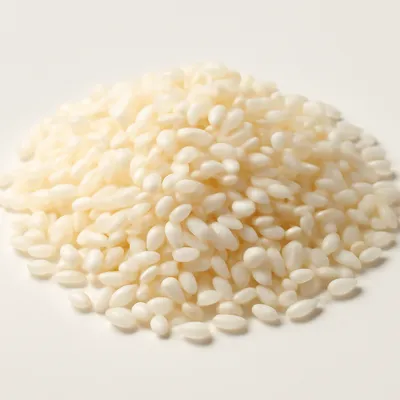
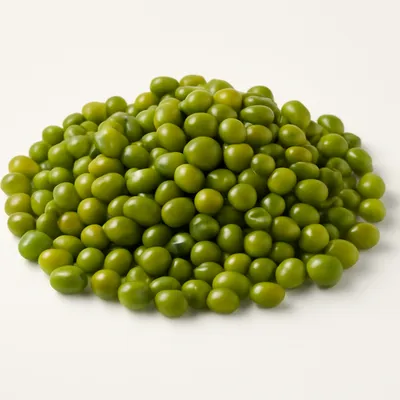

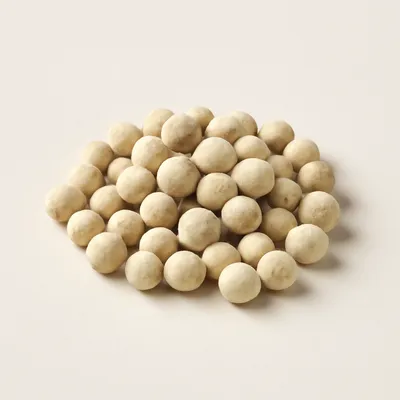


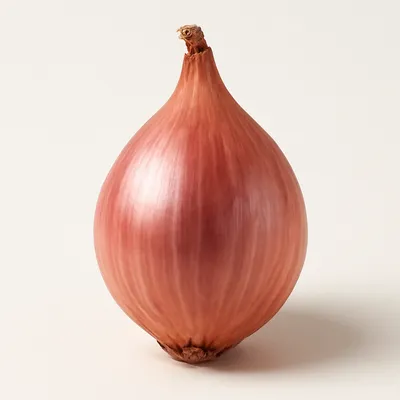
How it's made
7 steps · 2 hours active + 12 hours waiting
- 160 min
Soak 1kg glutinous rice 8 hours; drain, toss with 1.5 tsp salt. Soak 400g split mung beans 4 hours; drain, steam 25 minutes, mash with 1 tsp salt and 1 tbsp pepper to a firm paste.
Watch outEnsure the rice is fully soaked to achieve the right texture.
- 2120 min
Cut 500g pork belly into 8 strips, 2cm thick. Marinate 2 hours with 2 tbsp fish sauce, 1 tsp sugar, 2 tsp pepper, 4 minced shallots.
Watch outMarinate long enough for the flavors to penetrate the pork.
- 315 min
Wash 16-20 dong leaves (la dong); strip the central rib so they fold flat. Trim to size. Wipe clean — no flame needed; dong leaves are naturally pliable.
Watch outThe dong leaves should fold flat without cracking once the rib is stripped — if a leaf splits, swap it or juice leaks out during the long boil.
- 410 min
On a wooden mould (15x15cm) or by hand, lay 4 leaves crosswise, dark side down. Press 1 cup rice into a flat 15cm square. Press a 1cm layer of mung bean paste on top, leaving a 1cm border. Lay 2 pork strips. Cap with bean paste, then 1 cup rice — sealing the pork.
Watch outEnsure the layers are even to prevent uneven cooking.
- 515 min
Fold leaves up over the cake into a tight square parcel. Tie with 4 lengths of bamboo string in a cross pattern, just tight enough to hold — the rice will swell and tighten the parcel. Repeat for remaining 3 cakes.
Watch outTie just snug, not tight — the rice swells as it boils and will cinch the parcel itself; bind it too hard now and it bursts.
- 6720 min
Pack cakes upright in a deep pot, fill with cold water to cover, weight with a plate. Bring to a boil, then maintain a hard simmer 10-12 hours, topping up with boiling water as needed.
Watch outKeep it at a steady hard simmer for the full 10-12 hours and top up with boiling water — let the water drop below the cakes and the rice cooks unevenly.
- 730 min
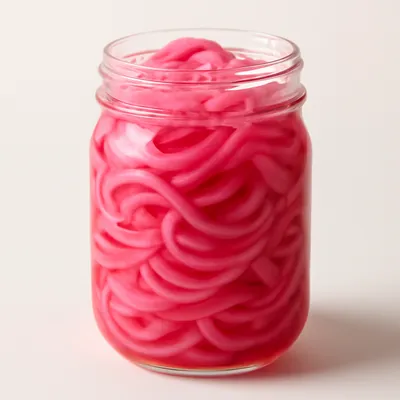
Lift out and rinse with cold water; press under a heavy board 4-6 hours to compact and to expel excess water. Cut with a strung loop into 6 or 8 wedges, leaf still on. Serve with pickled scallion (cu hanh muoi) and dua hanh (pickled red onion).
Watch outPress under a heavy board for 4-6 hours before slicing — this is what gives clean sharp-cut faces instead of a crumbly wet mess.


