
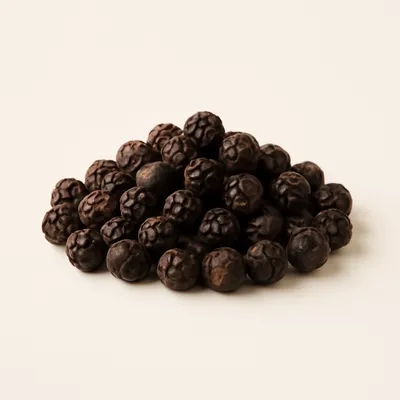
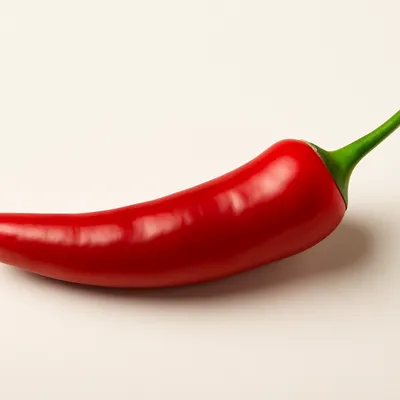
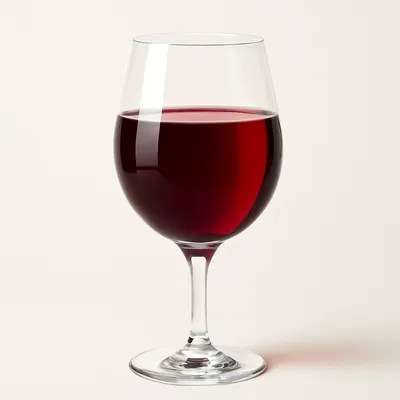
Calabrian pressed dry salami — coarsely-chopped lean pork (leg and shoulder) plus selected fat, mixed with salt, black pepper, and Calabrian chili peppers (with wine); fennel seed appears only in some regional variants, not the DOP standard, pressed flat between boards during aging to develop the characteristic squared shape, then cellar-aged 8-12 weeks.
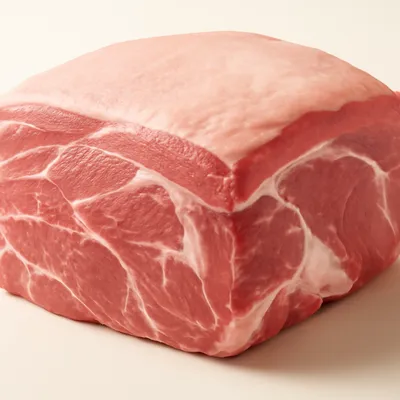



Soppressata Calabrese (DOP 1998, EC Reg. 134/98) is one of Calabria's four protected DOP cured meats (along with capocollo, pancetta, and salsiccia — 'nduja is not a DOP). The name comes from the production technique: after stuffing into casings, the salami are pressed flat between wooden boards for 3-5 days during early aging, creating the characteristic flattened-oval cross-section. The recipe uses coarsely chopped (not ground) lean pork from the leg and shoulder, with carefully selected fat — the chunky texture distinguishes soppressata from finer-textured salami like 'nduja. The chili content varies: 'soppressata dolce' (sweet) has black pepper only, 'soppressata piccante' has Calabrian chili peppers. Every Calabrian family with a pig slaughters in November and makes soppressata to be eaten through spring. The 8-12 week aging develops complex flavor; longer aging is possible but the meat hardens.
A paper-thin slice of soppressata reveals the marbling: 80% lean ruby with 20% snowy-white fat in irregular chunks (the chunky chop, visible). The bite is firm-yielding, the fat melts on the tongue and releases pork sweetness, the lean delivers iron-deep flavor concentrated by 8 weeks of moisture loss. Black pepper perfumes everything (with fennel only in some regional versions). The piccante version adds heat that builds slowly across multiple bites. One thin slice is enough for a full bite of bread; six slices is an antipasto course. Eat with raw garlic on bread and a glass of Cirò; this is mountain-Calabria itself on a plate.
Coarse hand-chopping (vs grinding) preserves muscle fiber structure, giving soppressata its characteristic chunky-mosaic cross-section and chewier bite — ground salami like 'nduja has smooth uniformity. The pressing technique flattens the salami evenly, distributes fat throughout, and accelerates the early-stage water release (3-5 days under pressure ≈ 10 days hanging). The 2% salt cure dehydrates the meat by osmosis over weeks, concentrating flavor and killing pathogenic bacteria. Curing salt (#2) is essential — sodium nitrate slowly converts to nitrite, preventing Clostridium botulinum growth during long ambient-temp aging.
Variations
Calabria DOP canonical (Cosenza, Catanzaro, Vibo Valentia, Crotone, Reggio) uses 80/20 lean-fat + Calabrian chili; Cosenza variant uses more fennel seed; modern Reggio producers experiment with smoked oak (controversial — not traditional); commercial Calabria-style soppressata sold outside Italy is often inauthentic (lower chili, smoother grind, shorter aging); home-cured versions require strict temperature control and curing salt; the 'soppressata di Vibo' is a regional sub-style specific to that province.
On the Palate
Where Soppressata Calabrese sits in the Italian flavor cloud
Ingredients
Serves 16

How it's made
8 steps · 1 hour 30 min active + 6 days 22 hours 30 min waiting
- 110 min
Acquire 3kg fresh pork shoulder (lean, 80%) + 1kg pork belly (fat, 20%) — total 4kg. Pork must be extremely fresh (within 24h of slaughter) and very cold.
- 232 min
Hand-cut meat into 1.5cm chunks (do NOT grind — coarse chop defines soppressata). Mix lean and fat. Place in freezer 30 min to firm up.
Watch outHand-cut the meat into 1.5cm chunks — do not grind; the coarse chop is what gives soppressata its chunky mosaic slice and chewy bite, and keep it cold so the fat stays firm.
- 35 min
Make seasoning: 80g sea salt (2% of meat weight) + 3g curing salt #2 + 60g coarse black pepper (for dolce) OR 60g black pepper + 80g Calabrian chili pepper flakes (for piccante) + 15g fennel seeds + 5 garlic cloves crushed in 100ml red wine.
- 410 min
In a large bowl, combine cold pork chunks + seasonings + the wine-garlic mixture. Mix thoroughly with very cold hands or paddle, 8 min — should be well-combined but still chunky, not smooth.
Watch outMix with very cold hands just until the seasoning is even — it should still look chunky, not smeared into a smooth paste, or you lose the mosaic texture.
- 515 min
Stuff into 5-6cm-diameter natural hog casings, in 25cm lengths. Tie ends with butcher's twine. Prick all over with a sterile needle.
- 66000 min
Press: place salami between two wooden boards weighted with 5kg of weight (water-filled bottles work). Press at room temp (15-18°C) for 24 hours, then move pressed salami (still between boards, weighted) to cool cellar (10-12°C, 75% humidity) for 3-4 more days.
- 74000 min
Remove boards. Hang salami in cellar (8-12°C, 70-75% humidity) for 8-12 weeks, turning weekly. White mold (beneficial Penicillium) will develop on casing — this is desirable. Black mold should be wiped off with vinegar-water.
Watch outWelcome the powdery white mold on the casing — that's the good stuff; only fuzzy black patches are trouble, and those get wiped off with vinegar water.
- 88 min
Soppressata is ready when firm but with slight give, color is deep ruby, and the cross-section shows clear lean-fat mosaic. Slice paper-thin and serve as antipasto with bread, pickled vegetables, and red Calabrian wine.
Watch outIt's cured when it feels firm with just a little give and the cut face shows a clear ruby lean-and-fat mosaic — still soft in the middle means it needs more hanging time.
Archive tool suggestions — not reviewed
These legacy suggestions have not been evidence-reviewed and are not presented as required tools.


