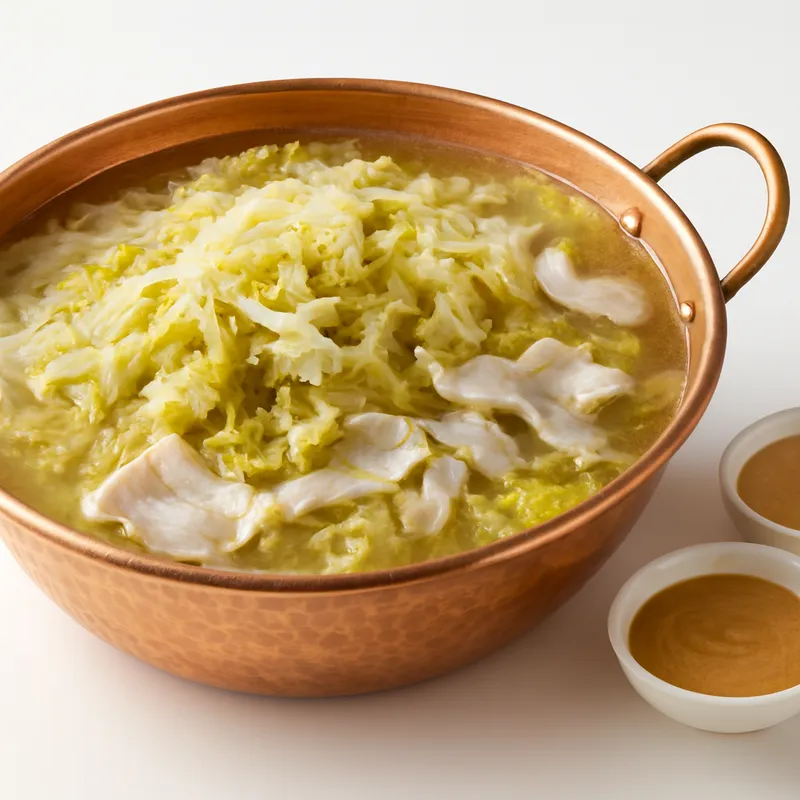
Whole duck and a Jinhua ham knuckle sealed together in a clay pot and braised at the gentlest heat until the broth turns milky white and the duck collapses into butter-tender, ham-scented richness—a Jinhua classic nicknamed 'Immortal Duck' for the almost effortless depth it achieves.





Ham-Knuckle Immortal Duck is one of Jinhua's most celebrated dishes, built on the region's most prized product. The '火踵' (fire-knuckle) is the rounded hoof-end of Jinhua ham—the cut richest in collagen and cured fat. Whole duck and the ham knuckle are placed together in a sealed clay pot with rice wine and aromatics and braised over the lowest possible flame for around two hours, traditionally timed by burning three sticks of incense. The dish is the signature offering of Jinhua's established old-line restaurants, including Qinghe Yuan (清和园), and appears in every major edition of Zhejiang cuisine cookbooks. A popular legend explains the 'immortal' in the name: an elderly sage taught a young monk to braise duck by this method, instructing him to use incense rather than a clock to judge the cooking time; the monk brought the technique back to Jinhua's streets and the name 神仙鸭子 (Immortal Duck) spread through the city. The legend is traditional in character—its function is to explain the dish's unusual name and the incense-timing method, not to establish a verifiable founding date.
The pot arrives at the table still gently simmering, releasing a cloud of aromatic steam scented with Jinhua ham and rice wine. Duck meat is butter-tender, collapsing from the bone with the lightest encouragement. Sliced ham knuckle is crimson-white, its cured salt mellowed by hours of braising into a deep, rounded richness that simply dissolves on the tongue. The broth is milky white and velvety, tasting simultaneously of cured salt, fresh duck fat, and the clean warmth of aged rice wine—savory, sweet, and gentle all at once.
Jinhua ham concentrates inosinate (IMP) and free glutamates through more than a year of salt-curing, proteolysis, and air-drying. When combined with duck—itself a significant source of glutamate and inosinate—the two sets of compounds produce synergistic umami enhancement: the broth's savory depth far exceeds what either ingredient yields alone. The ham knuckle's abundant collagen, concentrated in the hoof end of the cured leg, hydrolyzes into gelatin during the long braise and is the primary reason the broth turns milky white and takes on a velvety body. Sealing the clay pot minimizes water evaporation, maintaining near-constant temperature and preserving volatile aromatic compounds that would otherwise escape as steam, which is why the dish smells so intensely aromatic when the lid is first raised at the table.
Variations
Restaurants commonly halve the duck for easier portioning. Some cooks add silken tofu or napa cabbage in the final fifteen minutes to absorb the broth. Hangzhou restaurants sometimes substitute Shaoxing aged rice wine for Jinhua's local variety, yielding a slightly sweeter, more floral result. A version using chicken in place of duck—火踵神仙鸡—exists and is simpler but milder. The simplest old-style preparation omits all aromatics except ginger, trusting the ham and duck to generate all flavor unaided.
On the Palate
Where Ham-Knuckle Immortal Duck sits in the Chinese flavor cloud
Ingredients
Serves 4How it's made
7 steps · 20 min
- 115 min
Blanch the whole duck in boiling water 3 minutes to remove blood and surface impurities; separately blanch the ham knuckle in fresh boiling water 5 minutes; drain and rinse both under cold water
- 25 min
Place a bamboo mat in the bottom of a large clay pot to prevent direct contact with the heat source; set the duck breast-side down and the ham knuckle alongside; tuck in scallion knots and ginger slices; pour in rice wine
- 310 min
Add cold water to cover all ingredients by 3cm; set over high heat and bring to a full rolling boil; skim off all foam carefully with a ladle
Watch outSkim every bit of foam as it first boils — this is the milky-white broth, and unskimmed scum turns it cloudy and off.
- 45 min
Seal the pot lid securely with wet dough pressed around the rim, or use several tight layers of aluminum foil; reduce heat to the absolute minimum
- 5150 min
Simmer undisturbed 90 minutes; briefly unseal the pot, flip the duck carefully, reseal, and continue simmering 45–60 minutes until the duck is completely tender and the broth is milky white
Watch outSimmer until the duck's fall-apart tender and the broth's turned milky white — that white is collagen from the ham knuckle emulsifying, the sign it's ready.
- 615 min
Remove the ham knuckle; debone it and slice the meat into thick pieces; return the slices to the pot, arranging them over the duck
- 710 min
Season to taste with salt and a splash of fresh rice wine; reseal and simmer 5 final minutes; bring the sealed clay pot directly to the table and unseal dramatically at the moment of serving
Archive tool suggestions — not reviewed
These legacy suggestions have not been evidence-reviewed and are not presented as required tools.