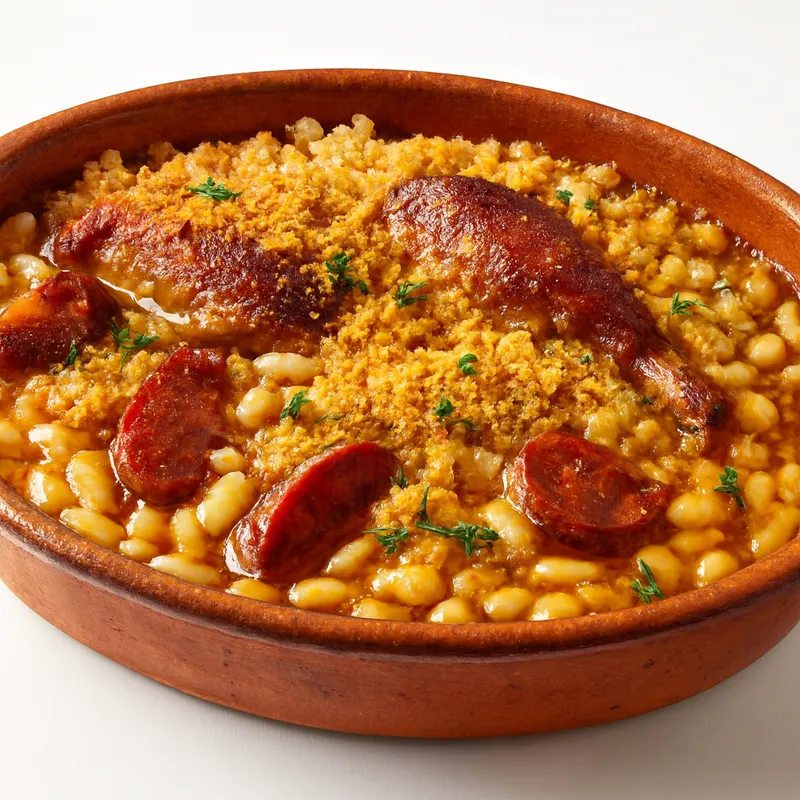
One-pot stew of cured smoked pork, fresh shoulder, smoked sausage, leeks, cabbage, carrots, turnips, potatoes, and white beans — slow-cooked 3 hours, the farmhouse winter staple of eastern Lorraine.
Potée is the eastern French countryside's name for a one-pot meat-and-vegetable stew; the Lorraine version specifically uses the local cured pork (lard fumé) and the smoked Morteau or Montbéliard sausage from the neighbouring Franche-Comté. The dish appears in Lorraine farm cookery from at least the 17th century — it was the standard winter household pot, kept hot for two or three meals from one cooking. The 1903 Cuisine Lorraine recipe by Pierre Mainbourg standardised proportions; today village fêtes in Vosges still cook it in 50-litre cauldrons.
Eastern French country pot — uses local lard fumé and the smoked Morteau or Montbéliard sausage from neighboring Franche-Comté. Mainbourg's 1903 Cuisine Lorraine standardized proportions; Vosges village fêtes still cook it in 50-litre cauldrons. Salt management is the load-bearing detail — taste only at the end, the cured pork brings everything.
Two courses from one pot. First: a clear amber broth in a deep bowl, smoke-edged and rich, with a single sliced leek floating. Spoonful by spoonful, it warms from the throat down. Then the platter: pink-grey slices of smoked belly fat sandwiched in lean meat, soft cabbage wedges, crumbling potatoes, beans falling apart at the spoon. Mustard cuts everything; the bread soaks the platter juice. Eaten at the kitchen table on a January night with a Pinot Gris from the next valley.
Salt management is the load-bearing detail. Lard fumé and smoked sausage are heavily cured; if you don't desalt the belly and add salt automatically at the end, the broth becomes inedible — which is why every reliable recipe says taste at the end, not before. The order of additions also matters: roots and beans go in early to absorb meat-broth flavour; cabbage and potatoes go in late so they don't disintegrate; sausage goes in last so it doesn't burst. A vigorous boil at any stage clouds the broth — keep it at a bare simmer throughout.
Variations
Potée vosgienne (with smoked Morteau, mountain emphasis); potée champenoise (with goose preserve in Champagne); potée auvergnate (with stuffed cabbage in Auvergne); potée bourguignonne (with bacon-and-leek dominance).
On the Palate
Where Potée Lorraine sits in the French flavor cloud
Ingredients
Serves 6














How it's made
5 steps · 30 min active + 11 hours 30 min waiting
- 110 min
Soak 200g dried white coco beans (or haricots tarbais) overnight in cold water. The night before, also soak 500g lard fumé (smoked salt-cured pork belly) in cold water 2 hours, changing once, to extract excess salt — taste at the end.
- 290 min
In an 8L stockpot, place 800g pork shoulder + the desalted lard fumé. Cover with 4L cold water. Bring slowly to a simmer over 30 minutes — skim foam thoroughly. Add bay, thyme, 6 peppercorns, 1 onion clouted with cloves. Simmer 1.5 hours.
Watch outBring it up slowly and skim every bit of grey foam before it sinks back in — and never let it boil hard: a rolling boil clouds the broth for good.
- 345 min
Add the drained beans, 4 leeks (white parts in 5cm pieces), 4 carrots halved, 4 turnips quartered. Continue simmering 45 minutes — vegetables tender but holding shape.
Watch outMake sure the beans are fully drained to avoid excess water diluting the broth.
- 425 min
Add 1 small green cabbage cut in 6 wedges, 6 medium potatoes peeled, 2 fresh smoked saucisses de Morteau or Montbéliard pricked all over. Simmer 25 minutes.
Watch outPrick the sausages well to prevent them from bursting during cooking.
- 510 min
Lift meats and sausage onto a warm platter; slice the lard fumé and pork shoulder into thick portions. Arrange vegetables around. Taste broth — salt only if needed, pork was the salt source. Serve broth in bowls first, then the meat-and-veg platter, with strong Dijon mustard, cornichons, and crusty bread.
Watch outTaste the broth before you salt — the cured pork has already seasoned it, and salting on habit here is what ruins the pot.
Archive tool suggestions — not reviewed
These legacy suggestions have not been evidence-reviewed and are not presented as required tools.