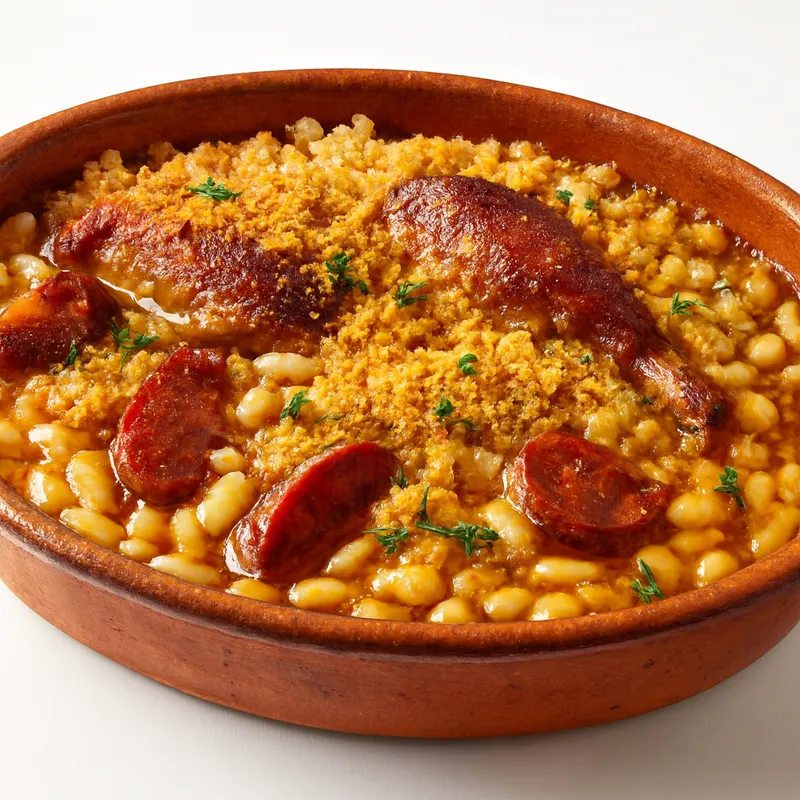






From Languedoc in southwest France, recorded by name in the 17th century but built on medieval bean stews. Three towns claim the canonical version — Castelnaudary (the prototype, pork-and-sausage base), Carcassonne (adds mutton or partridge), Toulouse (adds duck confit). The dish ties to the region's Tarbais bean and the duck-rendering tradition of the Gers.
This rich, hearty casserole is a testament to French comfort food, brimming with flavor and tradition from the Languedoc region.
A heavy earthenware crock pulled from the oven with a dark crust on top — under it, white beans collapsed into one another, duck-leg confit, a coil of garlic sausage, often a chunk of pork shoulder. Eaten with a spoon, not a fork. The crust is broken down into the beans and re-formed during baking; a Castelnaudary cook does this seven times.
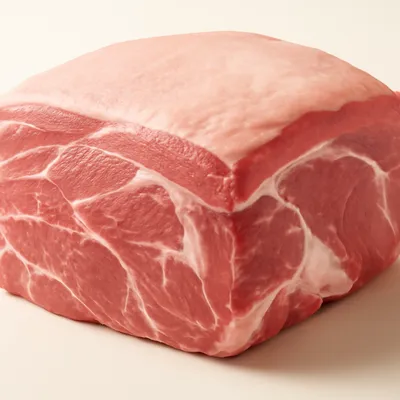
Tarbais beans are load-bearing — thin-skinned, they break down into the gelatin from the pork rind and confit fat to make the sauce thicken itself; no flour, no cream. The repeated breaking of the crust pushes Maillard flavor back into the pot. Use cannellini or navy and the dish goes mealy; skip the rind and the sauce stays thin.
Variations
Castelnaudary (most pork-heavy); Carcassonne (with mutton); Toulouse (with sausage); the breadcrumb crust is broken and re-formed seven times in the canonical version.
On the Palate
Where Cassoulet sits in the French flavor cloud
Ingredients






How it's made
5 steps · 30 min active + 2 hours waiting
- 110 min
In a large earthenware pot, brown the sausage and duck pieces in a splash of olive oil over medium heat until golden on all sides, about 10 minutes. Remove and set aside.
Watch outBrown the sausage and duck deep and golden on every side before they come out — that fond in the pot is the flavor floor for everything after.
- 25 min
Add chopped onions, garlic, and carrots to the pot, sautéing until the onions are translucent and fragrant, about 5 minutes. Stir in thyme and rosemary.
Watch outAvoid browning the garlic too much, as it can become bitter.
- 35 min
Return the meats to the pot along with the beans and tomatoes. Pour in enough stock to cover everything by about 2 cm. Bring to a gentle simmer.
Watch outMake sure the stock is hot before adding it to maintain the simmer.
- 45 min
Cover and transfer the pot to a preheated oven at 150°C (300°F). Let it cook slowly, allowing flavors to meld, for about 2 hours. Stir occasionally to prevent sticking.
Watch outHold the oven low so the pot barely trembles — a bare, lazy simmer melts the beans and rind into sauce; a hard bubble breaks the beans and leaves it thin.
- 55 min
Remove the pot from the oven and sprinkle breadcrumbs evenly over the top. Return to the oven, uncovered, and bake until the crust is golden and crisp, about 30 minutes.
Watch outBake uncovered until the breadcrumb top sets into a crisp, deep-golden crust — that browned lid is the signature, so let it truly color, not just dry out.
Archive tool suggestions — not reviewed
These legacy suggestions have not been evidence-reviewed and are not presented as required tools.
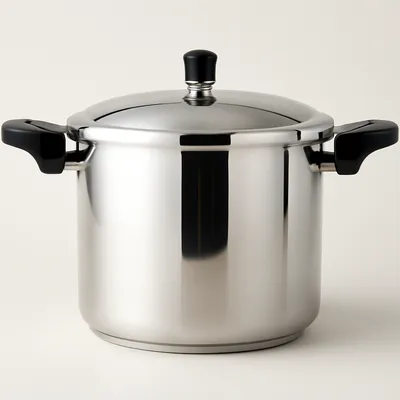
A sealed pot that lifts the boiling point of water from 100°C to ~120°C by trapping steam at 1 bar above ambient pressure. Tough cuts (oxtail, beef shank, dried beans) cook in 30 minutes instead of 4 hours; the higher heat denatures collagen faster than a long simmer. Modern electric versions (Instant Pot) automate the pressure cycle; old stovetop ones (Presto, Kuhn Rikon) hiss alarmingly but cost a fraction.

A small, thick-walled Korean earthenware pot, 12-18 cm across, that goes from gas burner to table. Its high thermal mass keeps soybean stews (doenjang jjigae), silken-tofu stews (sundubu jjigae), and steamed eggs (gyeran jjim) furiously bubbling for 10+ minutes after leaving the heat. The pot is meant to deliver food still actively cooking — a quirk of Korean meal pacing the Japanese donabe shares.