


Petits farcis is a household dish from the Niçois countryside — the original economy of using up yesterday's leftover meat (boiled beef, pot-au-feu scraps) by chopping it fine with herbs and breadcrumbs and stuffing into the day's market vegetables. The pork-and-veal mince version with no meat leftover is the modern restaurant codification. Each Niçois family has its herb signature; some add chopped Swiss chard or borage. The dish is always served warm or room temperature, never piping hot — a vestige of its origin as a make-ahead summer lunch eaten outdoors.
Niçois leftover-management dish — yesterday's pot-au-feu meat chopped fine, stuffed into the day's market vegetables. Pre-salting the hollowed shells is non-negotiable; without it, vegetable water boils the filling grey.
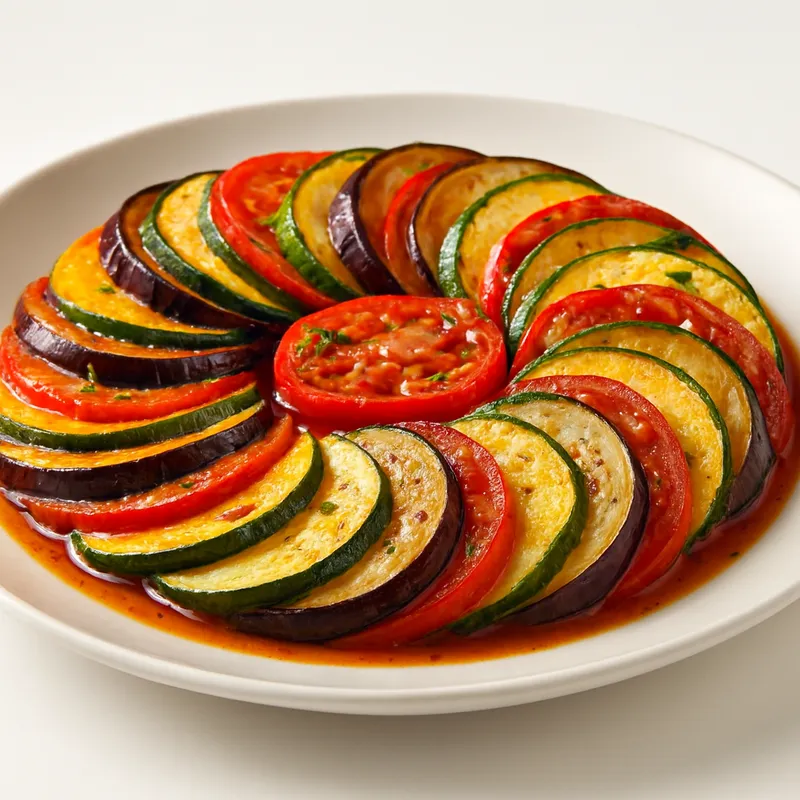
Four to six glossy half-collapsed vegetables on the plate, each top dark and crusted, sides bronze, the white wine and olive oil reduced to a slick at the bottom. Knife through a tomato: the wall has gone jammy-sweet, the filling steamy and herb-flecked. The courgette is mild and clean; the onion concentrates to candy under the skin; the pepper is the most assertive. You eat one of each, in any order. Filling that's still pink in the middle means you pulled them too early — internal needs 70°C.
Different vegetables cook at different rates — that's the technical challenge. Tomatoes go in 30 minutes; onions and peppers need 60+. The trade is to choose vegetables of similar density (small courgettes plus small bell peppers plus small onions plus small tomatoes) and accept that tomatoes will be on the soft edge by the time onions are done. The pre-salt-and-drain step on the hollowed shells is non-negotiable — without it, vegetable water runs out during baking and the filling boils instead of roasts, going grey.
Variations
Niçois canonical uses tomato, courgette, onion, pepper; inland Var version adds eggplant and Swiss chard; some households fold in chopped borage; restaurant codification swaps leftover boiled beef for fresh pork-veal mince.
On the Palate
Where Petits Farcis sits in the French flavor cloud
Ingredients
Serves 4





How it's made
5 steps · 1 hour active + 1 hour waiting
- 112 min
Choose 8 small vegetables (mix and match): 2 round courgettes, 2 small tomatoes, 2 small white onions, 2 small bell peppers. Slice off tops as lids. Hollow with a melon baller — keep flesh aside. Salt insides and invert on a rack 15 minutes to drain.
Watch outSalt the hollowed shells and let them drain cut-side down — pull this water out now or it floods the dish while baking and the filling greys instead of roasting.
- 212 min
Chop the reserved vegetable flesh fine. Sweat 1 chopped onion and 2 garlic cloves in 30g olive oil 5 minutes. Add the chopped flesh, cook 5 minutes to evaporate moisture. Cool.
Watch outEnsure the garlic does not brown to avoid bitterness.
- 38 min
Mix filling: 200g pork shoulder mince, 200g veal mince, the cooled vegetable base, 50g cooked rice, 1 beaten egg, 30g grated parmesan, 2 tbsp chopped parsley, 1 tbsp chopped basil, salt, pepper, grated nutmeg. Mix with hands but don't compact.
Watch outAvoid overmixing to keep the filling light and airy.
- 410 min
Pat vegetables dry. Stuff each with mixture, mounded 1cm above the rim. Press lid back on tomatoes and onions. Arrange in an oiled baking dish in a snug single layer. Drizzle with 40g olive oil. Add 100ml white wine to the dish.
Watch outEnsure the stuffing is not too packed to allow for even cooking.
- 560 min
Bake 180°C for 50 minutes — onions and peppers may need 60 minutes; tomatoes are usually done first. Tops should be dark brown, sides yielding to a knife. Rest 15 minutes — petits farcis taste better warm than hot.
Watch outBake until the tops are dark brown and a knife slides easily through the sides — onions and peppers lag, so judge by the firmest one, not the tomatoes.
Archive tool suggestions — not reviewed
These legacy suggestions have not been evidence-reviewed and are not presented as required tools.