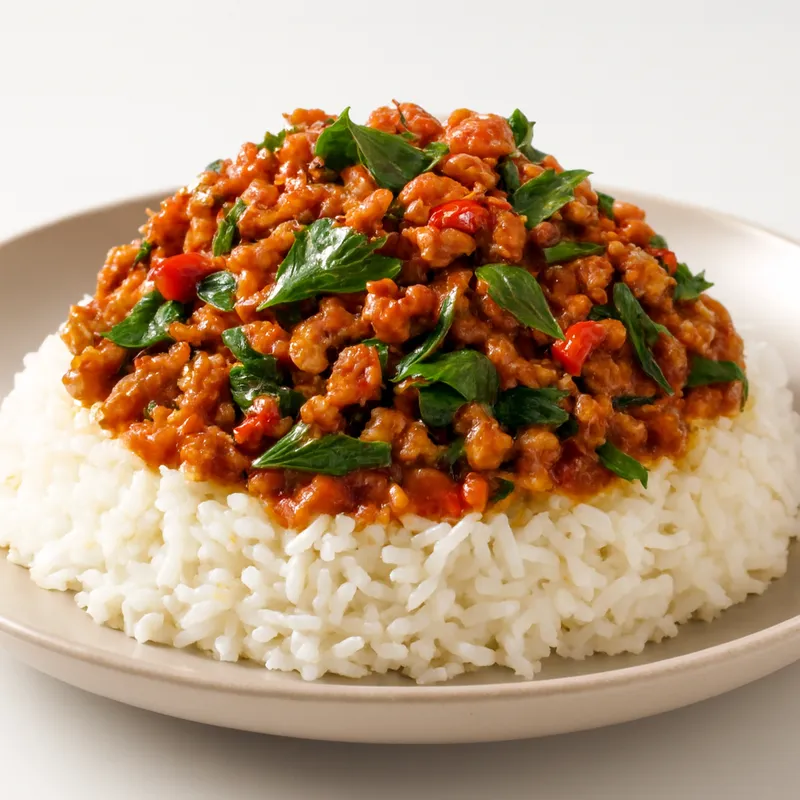
Squid stir-fried hard and fast with pounded garlic, Thai bird's-eye chiles, oyster sauce, fish sauce, and a final fistful of holy basil — served over rice with a fried egg (kai dao) on top.
Pad krapao is post-WWII Bangkok street food — the dish appeared in Central Thai cookbooks from the 1950s as chiles, garlic, and holy basil became the standard wok-shorthand. The classic protein is minced pork or chicken; the squid (pla muek) version is a coastal-and-port-city variant common at seafood-leaning rice-and-curry shops. The rule across all versions: the basil must be krapao (holy), not horapha (Thai sweet) — the leaf is the dish's namesake.
The squid version of post-WWII Bangkok pad krapao. Squid scored and seared under 90 seconds at high heat; krapao goes in off the heat or it loses fragrance in 30 seconds.
Hot wok-smoke off the plate, the squid's crosshatch curls catching glossy brown sauce. First bite: snap of squid ring giving against your teeth, then chile heat that climbs slowly, then the unmistakable peppery-clovey hit of holy basil — totally different from sweet Thai basil. The egg yolk breaks into the rice. If the squid is chewy or the basil tastes anise-licorice, the cook went too long or used the wrong basil.
Two technical loads: squid timing (under 90 seconds at very high heat, scored so it curls fast and stays tender) and the basil swap. Holy basil tastes peppery, slightly bitter, almost clovey — it survives high heat but loses fragrance after 30 seconds, so it goes in off-heat. Sweet basil (horapha) tastes anise-licorice and is wrong here; this is the most-failed move at non-Thai kitchens because the leaves look similar in markets.
Variations
Minced pork (moo sap) is the canonical; chicken (gai) is the most-ordered weekday version; beef (nua) is rarer; pla muek goes onto coastal menus from Hua Hin to Trat. Always topped with khai dao (fried egg, runny yolk).
On the Palate
Where Pad Krapao Pla Muek sits in the Thai flavor cloud
Ingredients
Serves 2




How it's made
6 steps · 12 min active + 3 min waiting
- 16 min
Clean 300g squid: remove beak and quill, score the inside of the body in a 5mm crosshatch, cut into 4cm squares. Tentacles cut into bite-sized clumps. Pat very dry on paper towel — wet squid steams instead of frying.
Watch outPat the squid bone-dry before it hits the wok — any water and it steams grey instead of searing.
- 23 min
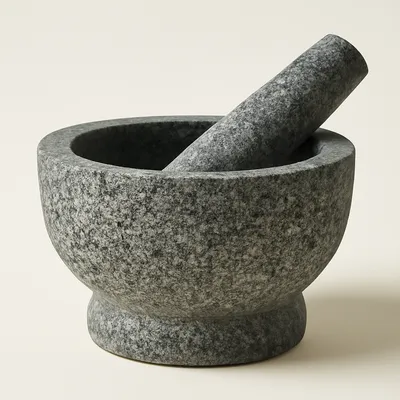
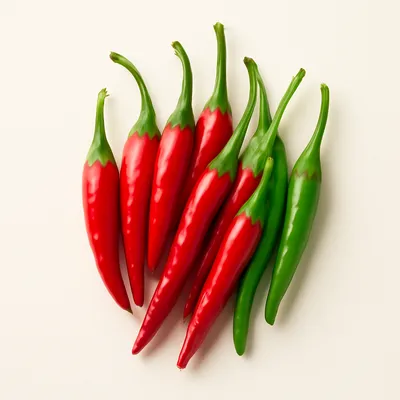
Pound 6 garlic cloves and 6-10 Thai bird's-eye chiles (prik kee noo) in a granite mortar to a coarse, fragrant paste — chunks should still be visible, not a smooth puree.
- 31 min
Heat a wok over highest heat with 2 tbsp neutral oil until it just begins to smoke. Add the chile-garlic pound; sizzle 10 seconds — sharp aromatic hit.
Watch outEnsure the oil is hot enough to sizzle immediately upon adding the garlic and chiles to avoid burning.
- 42 min
Add squid in one layer. Toss vigorously for 60-90 seconds — the rings curl and turn opaque white. Stop here; longer makes them rubbery.
Watch outToss the squid at highest heat 60-90 seconds only — pull it the moment the scored rings curl and turn opaque white; longer makes it rubbery.
- 51 min
Add 1 tbsp oyster sauce, 1 tbsp fish sauce, 1 tsp light soy, 1 tsp sugar, 2 tbsp stock or water. Toss 20 seconds to glaze.
- 63 min
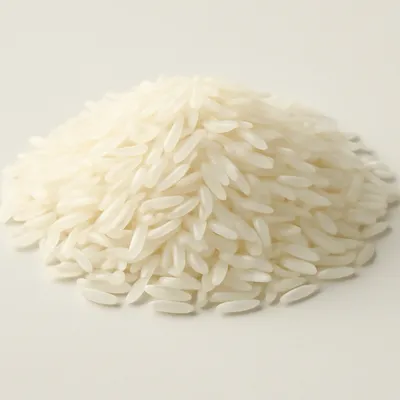
Off heat. Throw in 2 large handfuls of holy basil (krapao, NOT horapha sweet basil); fold once or twice — leaves wilt from residual heat. Plate over jasmine rice; top with a kai dao (egg fried in hot oil until edges are crisp-lacy and yolk runny).
Watch outThrow the holy basil in off the heat and fold just once or twice — it loses its fragrance after 30 seconds of cooking, so let the residual heat wilt it.
Archive tool suggestions — not reviewed
These legacy suggestions have not been evidence-reviewed and are not presented as required tools.