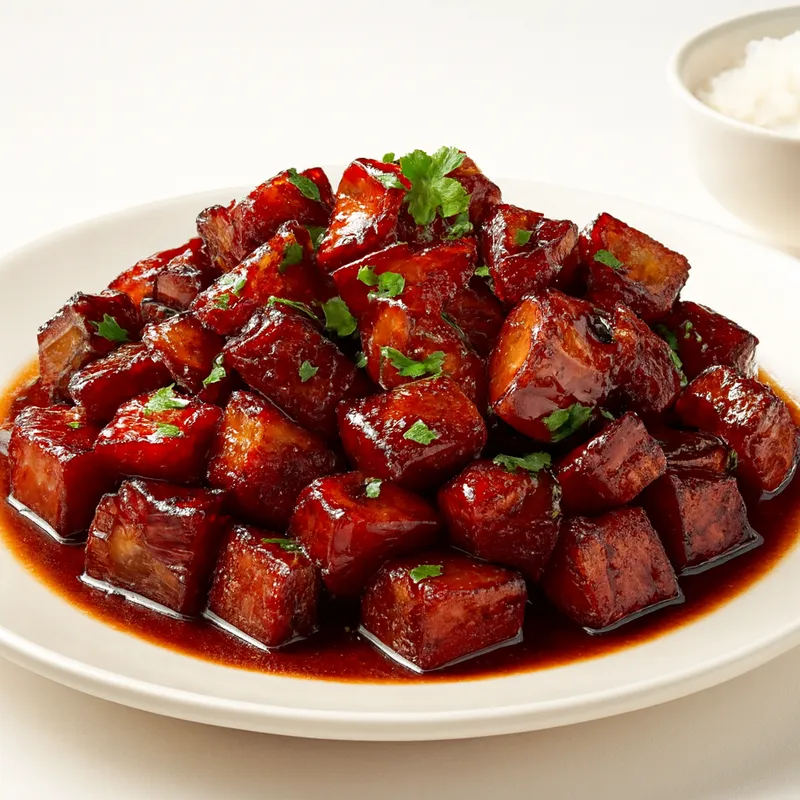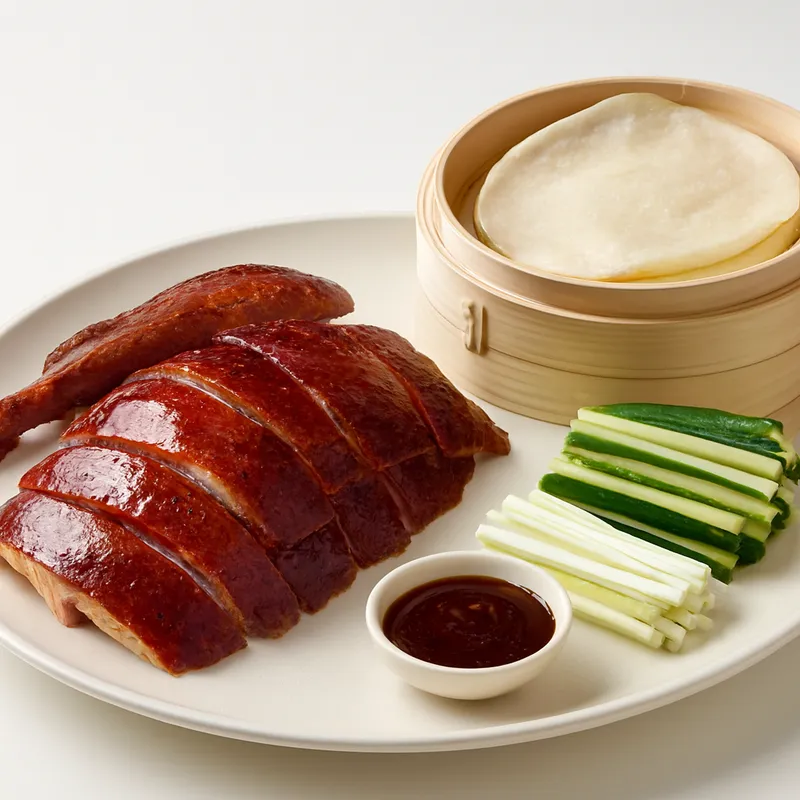
Iconic Beijing dish of air-dried whole duck roasted until the skin is lacquered and crispy, served with thin pancakes and hoisin sauce.



Recorded as 烧鸭子 ("roasted duck") in Yuan Dynasty palace cookbooks (1330), the dish became Peking Duck under the Ming court (15th century) when the capital moved to Beijing. Two restaurant lineages still battle: Bianyifang (since 1416, closed-oven 焖炉 method) and Quanjude (since 1864, open-oven 挂炉 method, hung over fruit-wood fire — apricot, peach, pear).
The grand spectacle of crispy skin and succulent meat, Peking Duck is like a culinary opera in Beijing. The perfect pancake wrap is a must.
The duck arrives whole, lacquer-mahogany, then carved tableside in two passes — skin first (almost no meat attached), then meat. Skin is rolled into a thin báobǐng pancake with sweet bean sauce, slivered scallion, cucumber. The skin shatters; the meat stays moist. Three to four bites per roll.
The skin's crackle comes from a 24-hour preparation: air is pumped between skin and flesh to separate them, the skin is glazed with maltose syrup, hung to dry overnight, then roasted. The maltose caramelizes at higher temperatures than sugar, creating the deep mahogany; the air gap renders the subcutaneous fat outward instead of into the meat. Without both steps the skin is leather, not glass.
Variations
Quanjude is brick-oven-roasted with fruitwood; Bianyifang style is hung-roasted in a closed oven; Cantonese siu yuk is the closest cousin in technique. The carving (108 slices) is the ritual.
On the Palate
Where Peking Duck sits in the Chinese flavor cloud
Ingredients





How it's made
5 steps · 52 min active + 1 day waiting
- 15 min
Pump air under the duck's skin through the neck cavity to separate skin from fat. This will result in a crispier skin when roasted.
Watch outWatch the skin balloon and lift evenly away from the flesh all over — an even air gap is what lets the fat render outward instead of into the meat.
- 23 min
Blanch the duck in boiling water for 2-3 minutes, then hang it up to dry. This tightens the skin and prepares it for glazing.
Watch outThe water must be at a violent rolling boil; watch the skin visibly tighten and contract in those two to three minutes before you hang it to dry.
- 34 min
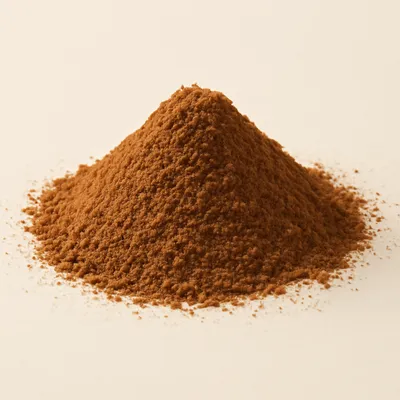
Glaze the duck with a syrup mixture including honey, soy sauce, and five-spice powder. The glaze should form a thin, even coat.
Watch outBrush until the coat looks thin, even and glossy with no pooling — a uniform film now means uniform mahogany color later.
- 40 min
Allow the duck to rest for 24 hours in a cool, dry place or a refrigerator to let the flavors develop and the skin dry.
Watch outAfter 24 hours the skin should feel dry, taut and papery to the touch, not tacky — that dryness is what guarantees the crackle.
- 540 min
Roast the duck in a preheated oven until the skin is a shiny brown and the meat is juicy. The aroma should be rich and inviting.
Watch outRoast until the skin is glossy deep-brown and crackling; watch the internal temperature so the meat stays juicy and the aroma turns rich, not scorched.