A Harbin cold-cut specialty: pork stomach used as a natural casing, stuffed with seasoned ground pork and Korean pine nuts, then boiled firm, pressed into shape, and lightly smoked until the casing turns amber — sliced thin and served cold.






松仁小肚 is a celebrated Harbin charcuterie specialty created by Wang Xiaoting (王孝庭), founder of 正阳楼 — a shop he opened in 1910 in the Daoli district of Harbin. A native of Shandong with deep traditional meat-curing expertise, Wang adapted the Beijing-style 风干小肚 (wind-dried stuffed pork stomach), associated with Beijing's 福星斋, to Northeast tastes: he adjusted the spice profile to local preference, added green-bean starch to refine the texture, and — crucially — folded in Korean pine nuts (红松松仁) from the Xiaoxing'anling forests, transforming a humble offal preparation into something that carries the prestige of the wild northeast. 正阳楼 went on to earn recognition as a 中华老字号 (time-honored Chinese brand), with 松仁小肚 and its wind-dried sausage as signature items. Korean pine nuts, harvested from the primeval red-pine (红松) forests of Xiaoxing'anling and Changbai Mountain, are one of Dongbei's most prized forest products. Harbin's traditional food shops still sell hand-stuffed, smoked 松仁小肚 as a prized New Year gift.
The smoked amber casing gives way to a cross-section of pale, glossy ground pork studded with golden pine nuts. First comes the resilient chew of the stomach wall, then the savory, silky pork filling, then a burst of pine-nut richness. The finish is a long, quiet curl of hardwood smoke. Perfect with baijiu or rice congee.
The pork stomach wall, composed of layered smooth muscle and mucosa, contracts during cooking to naturally compress the filling into a firm, clean-slicing form. Its abundant collagen hydrolyzes into gelatin during the 90–120-minute boil, then sets on cooling to bind the filling and allow even slices. Korean pine-nut oil (rich in oleic and linoleic acids) lubricates the ground pork matrix through lipid emulsification, giving the cut surface a glossy sheen. During smoking, phenolic compounds (guaiacol, eugenol) from hardwood combustion deposit on the outer stomach skin, creating the amber color, woody aroma, and antioxidant effect that extends shelf life.
Variations
Versions without pine nuts are called simply 小肚 or 肉肚, with a more austere, purer pork flavor. Starch-stabilized versions (using potato or corn starch) produce a softer, more yielding texture. Home recipes often season with Sichuan pepper, star anise, and cassia, producing a five-spice profile. Some Harbin shops briefly marinate the filling with a splash of sorghum baijiu for an extra aromatic layer.
On the Palate
Where Pine-Nut Pork Stomach Sausage sits in the Chinese flavor cloud
Ingredients
Serves 7


How it's made
8 steps · 30 min
- 120 min
Turn the pork stomach inside out. Rub both surfaces vigorously with flour and coarse salt to remove slime and odor. Rinse under cold running water and repeat the rubbing and rinsing 2–3 times until there is no off-odor.
Watch outRub with flour and coarse salt and rinse until the stomach has no slime and no off-smell left at all — any lingering odor will taint the whole sausage.
- 230 min
Mix ground pork with light soy sauce, rice wine, sugar, salt, white pepper, and ginger juice. Stir in one direction until the mixture becomes sticky and cohesive. Cover and marinate for 30 minutes.
- 35 min
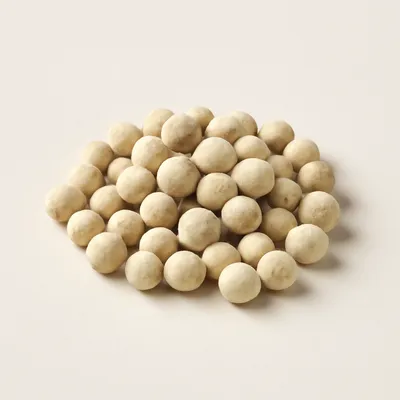
Dry-toast pine nuts in a clean wok over low heat, stirring constantly, until pale golden. Remove from heat, cool completely, then fold into the marinated pork mixture.
- 415 min
Turn the stomach right-side out. Leave one end open and fill with the pork and pine-nut mixture to about 80% capacity — do not overfill, as the stomach contracts during cooking. Tie both ends tightly with kitchen twine.
Watch outFill the stomach only about eighty percent — it contracts as it cooks, and a packed casing will burst.
- 590 min
Place the stuffed stomach in a pot of cold water with scallion sections, ginger slices, and Sichuan peppercorns. Bring to a boil over high heat, reduce to a low simmer, and cook for 90 minutes.
- 630 min
Remove from the pot and immediately place between two flat boards or heavy plates. Weigh down with a heavy object and allow to cool and press into an even, firm shape.
- 720 min
Once set, transfer to a smoker or improvised wok smoker with apple wood or elm wood chips. Smoke over medium-low heat for 20 minutes until the outer skin turns pale amber.
Watch outSmoke over medium-low just until the skin turns pale amber and smells of woodsmoke — push it hotter or longer and the surface goes bitter.
- 85 min
Allow to cool completely before slicing into rounds about 4–5mm thick. Serve cold, accompanied by garlic paste or Chinese mustard.
Archive tool suggestions — not reviewed
These legacy suggestions have not been evidence-reviewed and are not presented as required tools.