Thin yellow-cattle slices marinated in doubanjiang, fermented black beans, and homemade spiced rice flour, then loaded into bamboo baskets and blasted over high heat until the flour crust turns soft and glutinous around each piece. A cold drizzle of garlic water and a dusting of Sichuan pepper and chili powder finish each portion at the table. The gelatinized rice flour forms a clinging crust that seals in beef juices while cushioning the meat from the full intensity of the steam. The dish moves freely between registers — street breakfast eaten in its own small bamboo basket or a proud member of the traditional Sichuan nine-bowl banquet (九大碗).
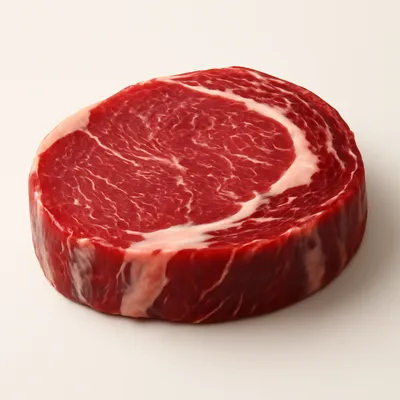





Steamed spiced-flour beef has roots in two Sichuan traditions: the steamed-dish culture of the rural nine-bowl banquet (九大碗), where flour-steaming was one of three canonical steaming methods alongside dry-steaming and clear-steaming; and the Zigong salt-field economy, where aging draft cattle supplied a steady stream of beef that local cooks worked into water-boiled, braised, and flour-steamed preparations. In Chengdu, the dish was refined into a restaurant specialty in 1934, when Yao Shucheng (1905–1983), a white-case cook from Dongzikou, opened Zhide Hao (治德号) on Changshun Middle Street. Yao sourced premium yellow cattle from the Huangchengba halal butcher, cut them into domino-shaped slices, and marinated them with doubanjiang, fermented black beans, Taihe red soy sauce, ginger water, and house-made two-rice flour — plus two closely guarded additions: stock drawn from mushrooms and white fungi, and baijiu infused with sea star and dates. Each portion steamed in a bamboo basket barely fist-sized — 8 cm in diameter, 4 cm tall — set atop an inverted wooden basin inside the pot so concentrated steam jets cooked each basket evenly. Painter Zhang Daxian was a devoted patron; he later included the recipe in his personal handwritten cookbook and recreated the dish for Zhang Xueliang at a Taipei banquet in January 1981. Zhide Hao relocated several times before closing in the early 2000s, receiving a Sichuan Time-Honored Brand (四川老字号) designation in 2006.
The basket arrives in a billow of steam carrying the warm, roasted-grain smell of spiced rice flour cutting through doubanjiang heat. A slice lifts on chopsticks — the flour crust has set soft and slightly glutinous, offering half a second of gentle resistance before it gives and releases beef juices. Sichuan pepper and chili arrive nearly together; a cold splash of garlic water cuts across with sharp brightness, and cilantro closes with a clean green note. The old Chengdu move is to split a sesame flatbread (锅魁) and pile the beef inside — the bread absorbs all the dripping steaming juices and becomes, many locals insist, the better half of the meal.
The dish pivots on two-rice flour (二米粉): 80% long-grain rice plus 20% glutinous rice, dry-fried with Sichuan peppercorn, star anise, galangal, and cinnamon until the grains turn pale gold and smell nutty, then coarsely ground. Toasting drives off moisture and develops roasted, nutty volatiles that raw rice flour cannot replicate. The coarse grind is deliberate — fine powder gelatinizes too quickly on contact with steam and collapses into dense paste; the coarser particles absorb the marinade during resting and then gelatinize gradually around each slice in the steamer, building a soft, clinging crust that seals cooking juices inside and buffers the rate of heat penetration into the muscle fibers, keeping the beef from toughening. The doubanjiang and fermented black beans have already penetrated the meat during marination; the steam's sole role is activating and blooming what is already embedded. The final garlic-water drizzle is cold by design: the sharp temperature contrast against the hot crust volatilizes the garlic's sulfur compounds on contact, producing a more aggressive, fresher aroma than warm garlic delivers.
Variations
Chengdu's individual-bamboo-steamer version (小笼粉蒸牛肉) is the most refined form — banquet-register, each diner receives their own fist-sized basket. Zigong and Yibin prefer large-bowl or communal-steamer versions with heavier doubanjiang and dried chili, closer in spirit to the salt-field roots of Sichuan beef cookery. The ancient town of Niufo (牛佛镇, whose name connects literally to cattle) has a breakfast variant using the rib-section cut known locally as 抱丹 meat, served without garlic sauce — just dry chili and Sichuan pepper powder — eaten as a morning meal. Home cooks often lay taro or sweet potato slices beneath the beef; the roots absorb the dripping marinade during steaming and, many families insist, end up more delicious than the beef itself.
On the Palate
Where Steamed Spiced-Flour Beef sits in the Chinese flavor cloud
Ingredients
Serves 4



How it's made
7 steps · 30 min
- 110 min
Make the spiced two-rice flour: combine 80g long-grain rice with 20g glutinous rice, then add 1 tsp Sichuan peppercorns, 2 star anise, a short piece of cinnamon, and 2 bay leaves. Dry-fry over medium heat, stirring constantly, until the grains turn pale gold and smell nutty, 8–10 minutes. Spread on a plate, cool completely, then pulse in a food processor or grind to a coarse crumb — sandy-textured, not fine flour.
Watch outToast the rice and spices only to pale gold with a nutty smell, then grind coarse and sandy — fine powder gelatinizes too fast in the steam and turns to dense paste.
- 25 min
Slice the beef across the grain into pieces about 5 cm long, 3 cm wide, and 0.5 cm thick — roughly domino-sized. Pat dry with kitchen paper.
- 315 min
Marinate the beef: finely mince 2 tbsp doubanjiang and roughly chop 1 tbsp fermented black beans. Combine with 1 tbsp soy sauce, 1 tsp finely grated ginger, 1 tbsp vegetable oil, and a pinch of white pepper. Add the beef, toss until every slice is coated, and leave for 15 minutes.
- 45 min
Add 4–5 tbsp of the spiced rice flour to the marinated beef and toss to coat each slice evenly. Every piece should carry a visible, clingy dusting. If the mixture feels dry, add 1–2 tsp water and toss again.
Watch outCoat every slice with a visible clingy dusting; if it looks dry and powdery, add a little water so the flour sticks and cooks into a smooth skin instead of falling off.
- 530 min
Arrange the coated beef slices in a single overlapping layer in a heatproof bowl or individual bamboo steamers lined with parchment or cabbage leaves. Set over a pot of vigorously boiling water.
- 65 min
Steam over high heat for 25–30 minutes, until the rice flour is fully cooked through and the beef is tender. Keep the boil strong the entire time; do not lift the lid before 20 minutes.
Watch outKeep the boil hard the whole 25–30 minutes and don't lift the lid before 20 — dropped heat leaves the rice flour chalky and half-raw at the core.
- 73 min
While the beef steams, prepare the finishing sauce: pound 3 cloves of garlic with a pinch of salt to a paste, then thin with 2 tbsp of cold boiled water. Separately combine 1 tsp chili powder and 0.5 tsp Sichuan pepper powder. Remove the beef from the steamer, drizzle the cold garlic water evenly across the surface, dust with the chili-pepper blend, scatter chopped cilantro, and serve immediately.
Archive tool suggestions — not reviewed
These legacy suggestions have not been evidence-reviewed and are not presented as required tools.


