




The savory martabak descends from Yemeni-Arab mutabbaq ("folded") brought by traders to Sumatra and the Malay world by the 19th century. The sweet version comes from Bangka island, where it is called terang bulan ("bright moon"); on Bangka, with its large Hokkien and Hakka Chinese community, it is known locally as hoklopan ("Hokkien cake"), pointing to a Chinese-migrant rather than purely Indonesian origin. It was repackaged under the martabak name in the 20th century. Two unrelated dishes share the name through street-vendor convention.
Two unrelated dishes share the name. Savory descends from Yemeni-Arab mutabbaq (folded), brought to Sumatra by 19th-century traders. Sweet is the Bangka island terang bulan (bright moon), repackaged under the martabak name in the 20th century.
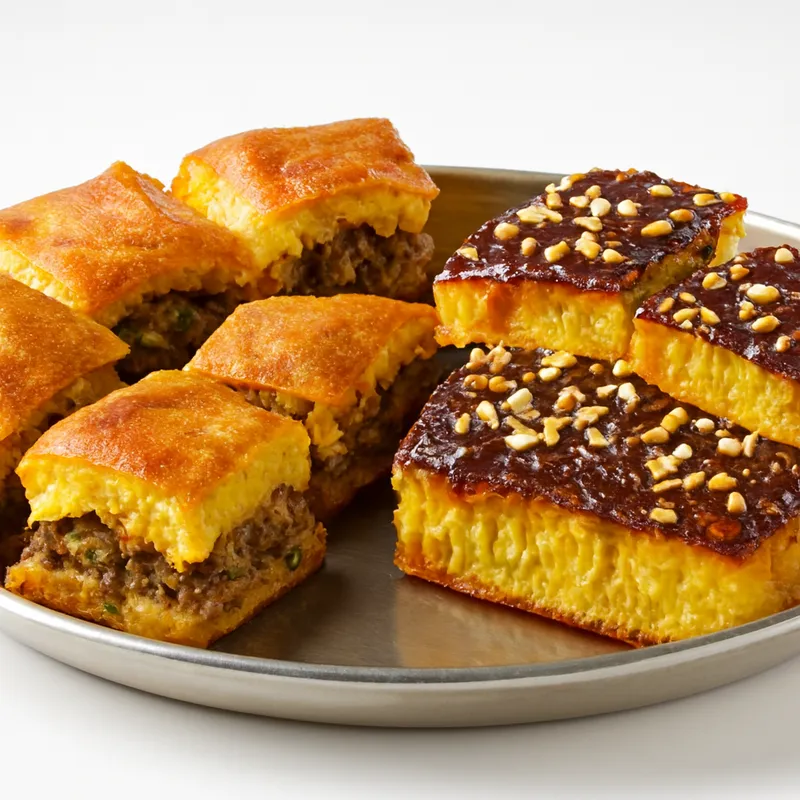
Two versions, same name. Savory (martabak telur): a thin dough sheet folded around beaten egg, minced beef or chicken, scallion, curry spice, then pan-fried crisp; eaten with pickled cucumber and chili-vinegar. Sweet (martabak manis): a thick yeasted pancake with bubbled, lacy top, slathered in butter, condensed milk, chocolate, peanuts, sometimes cheese, folded into a half-moon. Cut into thick wedges hot off the griddle.
The savory's trick is dough handling: a small ball stretched paper-thin by slapping on an oiled marble slab — too thin and it tears, too thick and it stays gummy in the middle. The sweet's bubbled top comes from baking soda hitting yeasted batter on a covered pan; lid trapped steam pushes the holes open. Without the lid, you get a flat pancake.
Variations
Martabak telur (savory egg-and-meat folded crisp); martabak manis / terang bulan (sweet thick yeasted pancake with chocolate-peanut-cheese-condensed-milk); martabak Aceh adds curry-spiced beef; martabak HAR in Palembang serves the savory with curry sauce poured over.
On the Palate
Where Martabak sits in the Indonesian flavor cloud
The whole dish rides on the dough: knead it slack and elastic, rest it, then stretch one oiled ball paper-thin so light shows through without tearing — too thick and the middle stays raw and gummy, too torn and the filling leaks and fries hard.
Ingredients




How it's made
5 steps · 31 min active + 15 min waiting
- 110 min
In a large bowl, mix flour with water and a pinch of salt to form a smooth, elastic dough. Knead until the dough is soft and pliable, then cover and let rest for 15 minutes.
Watch outKnead until the dough turns smooth and stretchy and springs back slowly when poked — that slack elasticity is what lets it go paper-thin later.
- 25 min
In a skillet over medium heat, melt a knob of butter. Add finely chopped onion and garlic, sautéing until translucent and fragrant.
- 35 min
Add minced meat to the skillet, cooking until browned and aromatic, about 5 minutes. Stir in spices, and let the flavors meld together.
Watch outMake sure the meat is fully browned to avoid a raw taste.
- 45 min
Roll out the dough into a thin sheet. Place the cooked meat mixture in the center, fold the dough over to encase the filling, creating a neat package.
Watch outStretch the dough until it's translucent enough to read light through, then wrap loosely — a taut over-stuffed parcel splits on the pan.
- 56 min
Heat a non-stick pan over medium heat and add a little butter. Cook the martabak until golden brown and crispy on both sides, about 3 minutes per side.
Watch outIt's done when both faces are deep golden and sound crisp when tapped, and the edges have sealed tight with no leaking juice.
Archive tool suggestions — not reviewed
These legacy suggestions have not been evidence-reviewed and are not presented as required tools.