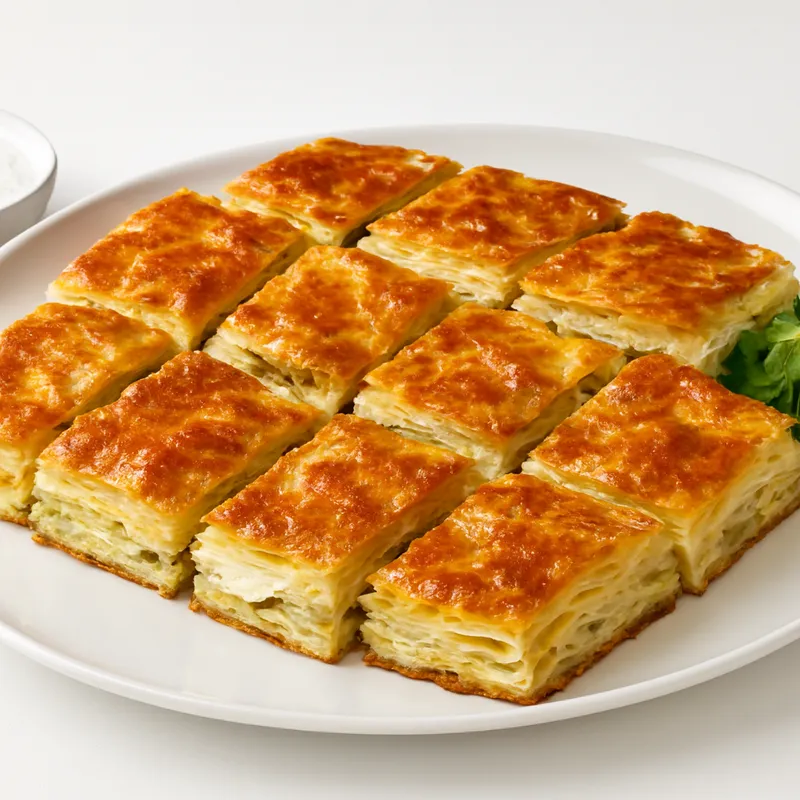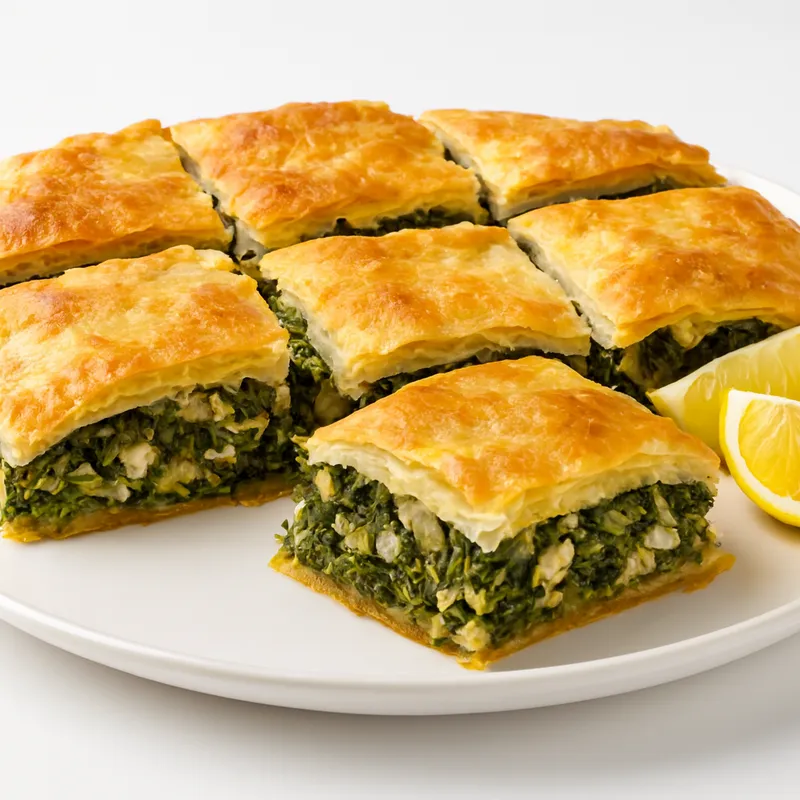




A descendant of Ottoman-era pita pies that spread throughout the Balkans and Anatolia; the Greek version traces to rural northern Greece (Epirus, Macedonia, Thessaly), where wild greens (horta) gathered from hillsides were the original filling, not cultivated spinach. Documented by name in Greek cookbooks from the 17th century onward, with feta as the standard binder by the 19th.
Epirot mountain pita — wild horta (greens), feta, olive oil, between sheets of hand-stretched phyllo. The phyllo must be brushed with oil layer-by-layer; butter is a Constantinople adaptation, not the village original.
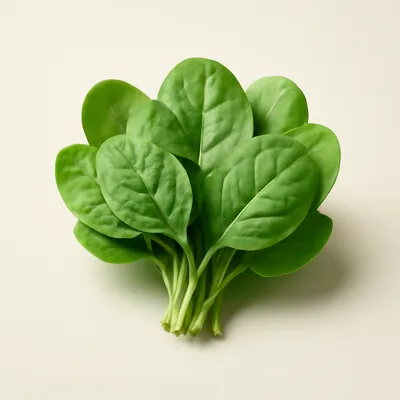
A flaky golden square or triangle, layers of phyllo so thin they shatter on the first bite, brushed between sheets with olive oil or butter. Inside: spinach wilted and squeezed dry, crumbled feta, dill, scallion, sometimes egg to bind. Eaten warm or room temperature. If the filling is wet, the bottom phyllo turns to paste — that's the failure mode.
Squeezing the spinach is load-bearing — wilted spinach holds shocking amounts of water, and any moisture left will steam through the phyllo and kill the crunch. Country-style versions (spanakopita horiatiki) use a thicker hand-rolled dough and are sturdier; the city-style with commercial phyllo is more delicate but punishes a wet filling.
Variations
Hortopita uses mixed wild greens (no spinach); kreatopita is the meat version; tyropita drops the greens for cheese only; Epirot batsaria uses cornmeal phyllo; Greek-American version often subs in puff pastry (faux).
On the Palate
Where Spanakopita sits in the Greek flavor cloud
Squeeze every drop of water out of the wilted spinach — any moisture left will steam through the phyllo from inside and turn the crust soggy instead of shatter-crisp.
Ingredients





How it's made
6 steps · 1 hour 22 min
- 15 min
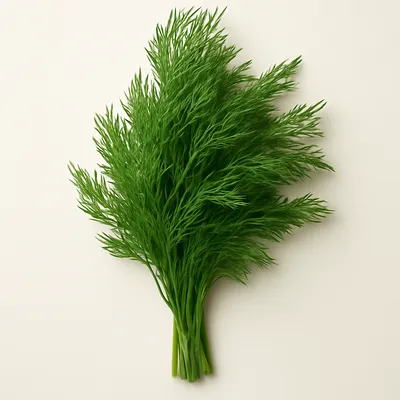
Preheat your oven to 180°C (350°F). Wash the spinach thoroughly, remove any large stems, and chop it finely. Place the spinach in a steamer over boiling water and steam for about 2 minutes until wilted and reduced in volume. Drain well, pressing out any excess liquid with the back of a spoon.
Watch outSteam the spinach only until it collapses — about 2 minutes — then drain and press; over-cooking just makes more water to fight.
- 27 min
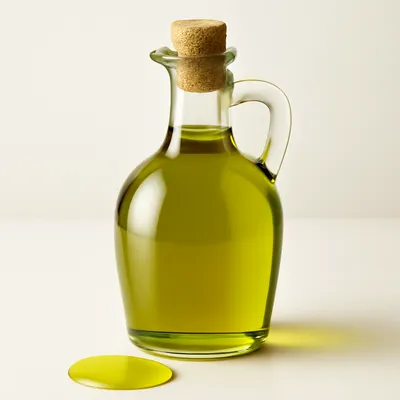
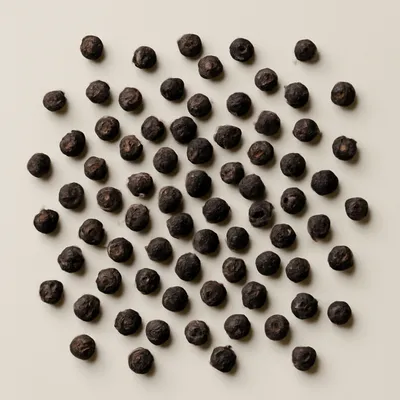
In a large skillet, heat the olive oil over medium heat until shimmering. Add the finely chopped onion and cook until slightly tender, about 3 minutes. Add the scallions and cook for another 2 minutes until limp. Remove from heat and stir in the parsley, dill, nutmeg, salt, and pepper.
Watch outDo not let the onions brown; they should be translucent.
- 35 min
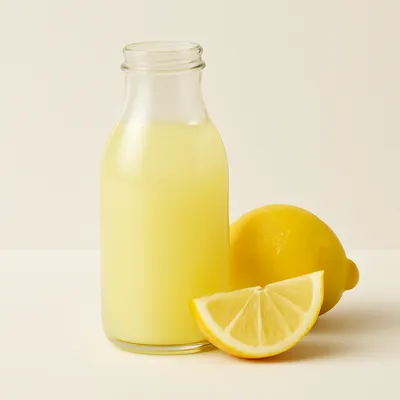
Stir the crumbled feta, cottage cheese, and grated parmesan into the skillet with the onion mixture. Add the drained spinach and lemon juice, mixing everything together. Gently fold in the beaten eggs until well combined.
Watch outAvoid overmixing to keep the filling light and fluffy.
- 410 min
Brush a 9x12-inch baking dish with clarified butter. Lay a sheet of phyllo dough across the bottom, letting edges fold up the sides. Brush with butter, then layer another sheet on top. Repeat until you've used about 8 sheets.
Watch outBrush every phyllo layer with butter right to the edges — dry patches won't crisp and will tear when you cut.
- 510 min
Spread half of the spinach filling evenly over the phyllo. Cover with another 5-8 sheets of phyllo, brushing each with butter. Spread the remaining filling on top, then cover with another 5-8 sheets, brushing with butter. Roll up any overhanging phyllo and drizzle with remaining butter.
Watch outEnsure even distribution of filling to prevent soggy spots.
- 645 min
Place the spanakopita on a medium rack in the preheated oven. Bake for 45 minutes or until the top is puffed and golden brown. Allow to sit for 10 minutes before cutting and serving.
Watch outIt's done when the top is puffed and deep golden and sounds crisp when tapped — pale means the bottom is still doughy.
Archive tool suggestions — not reviewed
These legacy suggestions have not been evidence-reviewed and are not presented as required tools.