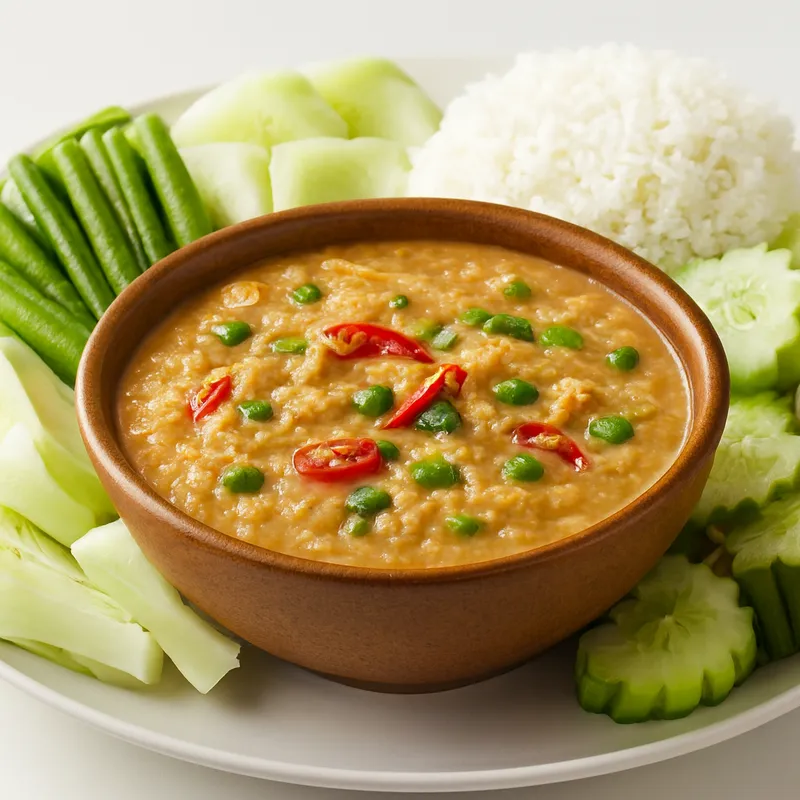
Khmer-Krom fermented-fish stew — fermented snakehead fish (mam) simmered in coconut milk with pork belly, eggplant, and pineapple, served with rice noodles and raw vegetables for dipping.
Mam (fermented fish) is the Mekong Delta's signature preserved-fish ingredient — distinct from Cambodian prahok or Vietnamese mam ca. The Khmer-Krom community in southwestern Vietnam (and adjacent Cambodian Mekong border) maintains the tradition of fermenting snakehead fish or mudfish in salt and rice powder for months, producing a paste that's foundational to many borderland dishes. Mam Trey simmers this preserved fish with fresh pork, vegetables, and coconut milk into a rich, deeply-fermented broth eaten over rice noodles with fresh herbs and raw vegetable wraps. The dish is uniquely Khmer-Krom — neither Cambodian-mainstream nor Vietnamese-mainstream — and represents the cuisine of the Mekong borderlands.
Spoon mam trey over a nest of rice noodles in a deep bowl: the broth is deep terracotta-orange, thick with coconut and pork fat, fragrant with lemongrass and lime. The fermented-mam funk is the first thing you notice — pungent, slightly cheesy, deeply umami; some find it shocking, regular eaters crave it. Pork belly slices float; pineapple chunks add fruity sweetness; eggplant has soaked up everything. Grab a piece of lettuce, fill with noodles + broth + herbs, wrap, eat. The wraps cleanse the palate between spoonfuls of the rich broth.
Fermented mam contributes 20+ free amino acids (glutamate, aspartate, plus less-common combinations) in concentrations 10-15× higher than fresh fish — this is what creates the dish's deep umami. Coconut milk provides fat that emulsifies the broth and softens the mam's intensity. Tamarind's tartaric acid (pH 2.5) and pineapple's bromelain enzyme both work to tenderize the pork belly during the 30-min simmer, while the lime juice added at the end provides bright top-notes that balance the deep fermented base.
Variations
Khmer-Krom original uses real mam ca loc (snakehead); the Vietnamese-mainstream cousin (e.g. bún mắm / mắm chưng) uses less coconut milk; Cambodian-Phnom-Penh version substitutes prahok for mam (lighter funk); diaspora restaurants in California often use bottled shrimp paste + fish sauce for accessibility.
On the Palate
Where Mam Trey sits in the Cambodian flavor cloud
The fermented mam is the whole flavor engine — mince it fine and dissolve it fully into the coconut broth, then let a slow 30-minute simmer marry its deep funk with the pork and round it off with lime at the end.
Ingredients
Serves 6
















How it's made
5 steps · 40 min active + 1 hour 20 min waiting
- 110 min
Prepare the mam (fermented fish): if available, use 100g real fermented mam ca loc (sold at Vietnamese-Cambodian Asian markets); otherwise substitute with 80g Thai pla ra or 100g shrimp paste + 1 tsp fish sauce for similar funky-umami profile. Mince fine.
- 211 min
In a heavy pot, render 300g pork belly (sliced thin) over medium heat 8 min until fat is golden and meat is browning. Remove pork (leaving rendered fat).
Watch outRender the pork belly 8 minutes until the fat runs golden and the edges brown — that fat carries the aromatics.
- 37 min
In the rendered fat, sauté 1 chopped onion + 6 minced garlic cloves + 2 inches grated ginger + 4 sliced lemongrass stalks + 2 sliced bird's-eye chilies for 6 min.
- 417 min
Add the minced mam + 2 tbsp tamarind paste + 1 tbsp palm sugar + 1 can (400ml) coconut milk + 500ml water. Stir to dissolve; simmer 15 min.
Watch outStir until the mam fully dissolves and the broth smells deeply savory, no raw lumps left.
- 535 min
Return pork belly to pot. Add 2 chunked Asian eggplants + 200g pineapple chunks + 1 tsp turmeric. Simmer 30 min until vegetables are tender and pork is melting. Add juice of 2 limes + 1/4 cup chopped Vietnamese coriander (rau ram). Serve over rice noodles with raw cucumber, lettuce, fish-mint, perilla, and bean sprouts for wrapping.
Watch outIt's ready when the pork turns meltingly soft and the eggplant collapses; then finish off-heat with lime.
Archive tool suggestions — not reviewed
These legacy suggestions have not been evidence-reviewed and are not presented as required tools.